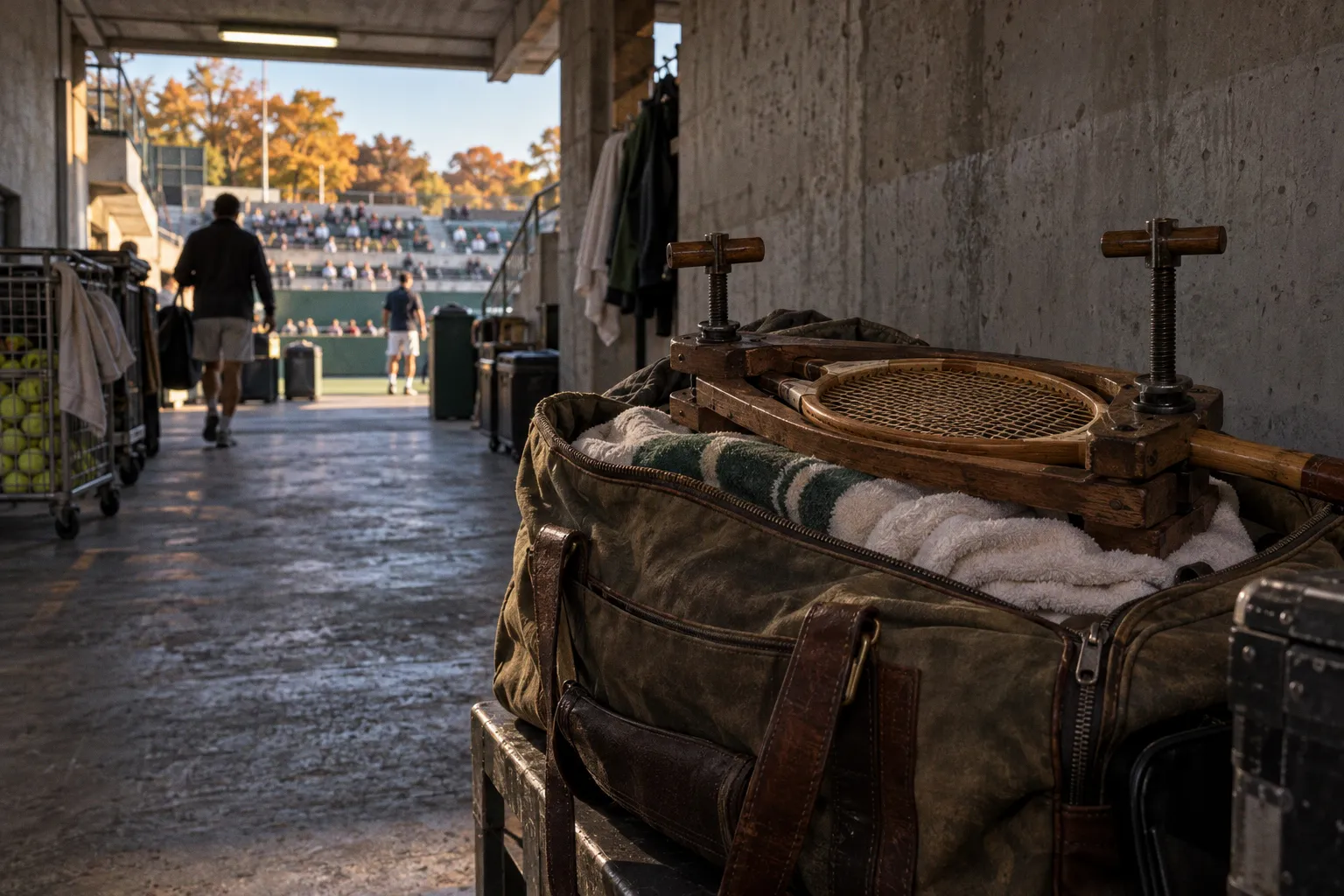
It begins in the hand: with weight, balance, vibration, and the narrow margin between a clean strike and a small, audible failure.
A traditional wooden racket commonly weighed between 400 and 500 grams, carried a head of roughly 65 to 85 square inches, and measured around 27 inches long by 9 inches wide. A modern graphite or composite frame can weigh as little as 250 grams, with a head generally ranging from 95 to 110 square inches. Those numbers describe equipment, but they also describe a change in tennis itself — from a game of restrained acceleration and precise placement to one built increasingly around racket-head speed, heavy spin, and repeatable baseline force.
The story of wooden tennis rackets vs modern graphite frames is therefore not simply a story of old materials being replaced by new ones. It is a story about what the player was required to feel, what the court allowed, and which kinds of tennis became easier to produce.
The tactile era: life with a 500-gram wooden frame
A wooden racket did not disappear quietly into the past. It remained present in the player’s arm, in the timing of every return, and in the slight resistance that accompanied a late preparation. Its mass was not a decorative inconvenience. It shaped the entire stroke.
At 400 to 500 grams, a wooden frame demanded that the player organize the swing early. There was less room for a hurried flick of the wrist, less forgiveness when the ball arrived awkwardly, and less possibility of manufacturing pace from a defensive position. The racket could still strike with authority, of course — the best players generated extraordinary speed with wooden equipment — but the route to that speed was more deliberate.
A small head, usually between 65 and 85 square inches, concentrated the strings into a much tighter striking area. The familiar sensation of the old racket was not merely that it felt heavy. It was that the ball seemed to ask a more exact question. Contact had to be found rather than broadly received.
This is where the lost art of touch is often misunderstood. Touch was not softness for its own sake, and it was not the absence of athletic force. It was the ability to manage force through the frame — to absorb, redirect, soften, and place the ball while keeping the racket face stable. A drop shot, a short-angled volley, a low slice, or a return chipped down the line all carried the imprint of the player’s hand more directly because the equipment offered less free assistance.
The frame’s flexibility mattered here. Wood absorbed more energy at impact than the stiffer graphite constructions that followed, reducing the maximum ball speed available from the same swing while enhancing the sensation of a held, guided contact. The ball did not simply rebound from the racket; the player had to remain engaged with the strike.
That engagement produced a particular kind of discipline. A wooden racket could not easily disguise a poor preparation or rescue a ball struck far from the center. When the contact was right, the reward was a controlled heaviness and a fine-grained sense of direction. When it was wrong, the frame announced the mistake through vibration, a muted loss of pace, or a ball that arrived short.
The wooden racket did not remove power from tennis; it made power more dependent on timing, balance, and the quality of the strike.
The dimensions reinforced this relationship. The classic wooden frame was approximately 27 inches long and 9 inches wide, while the modern Rules of Tennis permit frames up to 29 inches in length and 12.5 inches in width. The comparison is not a simple measurement of progress — larger does not always mean better — but it reveals how much more surface and leverage became available as racket technology developed.
A larger head increases the practical area in which the ball can be struck effectively. It also gives the player more confidence when arriving late or stretching wide. The modern racket is not only lighter; it is more accommodating. That accommodation has changed the rhythm of professional tennis as profoundly as any tactical fashion.
The physics of flexibility: why wood demanded a different swing
The material history of tennis rackets is really a history of stored and released energy.
Wooden frames were flexible and comparatively low in stiffness. Modern graphite frames are commonly described through stiffness ratings in the region of RA 55 to RA 72, depending on construction and model. A stiffer frame deforms less during impact and returns more of the collision’s energy through the strings and ball. In the hand, the effect can be immediate: a firmer response, a more direct launch, and a greater sense that the racket is contributing to the pace.
That does not mean that every graphite racket is harsh, nor that every wooden racket was gentle. Those are crude conclusions. The meaningful distinction lies in how much of the shot’s outcome is supplied by the player’s timing and how much can be recovered through the frame’s size, stiffness, and speed.
A wooden racket rewarded a compact relationship between body and ball. The player had to arrive with the racket in position, keep the head steady, and meet the ball cleanly enough for the flexible frame to do its limited work. On a fast court, this made the return of serve a particularly exacting act. There was little opportunity to swing late and still create a deep, heavy reply.
With graphite, the calculation broadened. A lighter frame could be accelerated more quickly, and the larger head offered a wider margin for imperfect contact. The player could defend from further behind the baseline, lift a ball with more racket-head speed, and produce greater rotation without needing the same heavy wooden mass moving through the shot.
The arrival of graphite did not create topspin by itself. The modern forehand still depends on grip, swing path, body rotation, contact height, and timing. But graphite made certain combinations easier to repeat — particularly the fast, high-to-low-to-high swing that produces a ball with both pace and shape. The frame could withstand a more violent acceleration while giving the player a larger, stiffer platform from which to work.
This is the central point in the evolution of tennis racket technology: equipment did not merely amplify an existing style. It altered which styles were practical under pressure.
A wooden frame could produce a penetrating drive, but it was less naturally suited to the constant, high-margin acceleration now associated with the modern baseline. Its smaller head and greater weight placed a premium on preparation. Its flexibility made it excellent for feeling the ball, but less efficient for producing repeated explosive exchanges from deep court position.
Modern equipment, by contrast, makes it easier to generate a ball that is both fast and heavy. That combination changes the geometry of the rally. A player can strike with substantial spin, clear the net by a safer margin, and still push the opponent backward. The shot is not simply travelling faster; it is arriving with a different kind of friction and kick.
A direct comparison
| Feature | Traditional wooden rackets | Modern graphite and composite frames |
|---|---|---|
| Typical weight | Approximately 400–500 grams | Can weigh as little as 250 grams; many performance frames sit above that minimum |
| Head size | Roughly 65–85 square inches | Commonly about 95–110 square inches |
| Frame response | More flexible, absorbing more energy | Generally stiffer, returning more energy through the strike |
| Margin for error | Narrower sweet spot and more demanding contact | Larger effective hitting area and greater forgiveness |
| Swing demands | Early preparation, controlled acceleration, precise timing | Faster racket-head speed, greater access to pace and spin |
| Typical tactical effect | Placement, touch, anticipation, and all-court variety | Baseline pressure, heavy topspin, and sustained power |
| Storage | Vulnerable to moisture and tension-related warping | More dimensionally stable, though still affected by strings and conditions |
The word “sweet spot” needs some care here. Modern frames generally offer a larger effective hitting area than wooden rackets, but this does not mean every part of a graphite head feels identical. The point is not that graphite eliminates technique. Rather, it reduces the punishment for being slightly late, slightly wide of center, or caught in an awkward defensive position.
That reduction in punishment is one of the quiet revolutions of modern tennis. It allows the player to remain aggressive more often, because a marginal strike is less likely to collapse into a harmless ball. The game becomes more physically demanding in one sense — the ball is heavier, the exchanges more explosive — while becoming more forgiving at the instant of contact.
The 1982 turning point: Mats Wilander and the graphite revolution
The transition from wood to graphite was not a single switch thrown across the professional game. Graphite was introduced into tennis racket manufacturing during the 1970s, and the change gathered force gradually, as players and manufacturers learned what composite construction could offer.
The symbolic weight of the early 1980s comes from the careers of players who stood on either side of the transition. Björn Borg retired from professional tennis in late 1981 after playing exclusively with wooden rackets throughout his prime. His game — built on extraordinary timing, physical endurance, and a heavy, controlled baseline ball — showed how much could be achieved with a frame that now appears technically austere.
Then, in 1982, Mats Wilander won the French Open using a graphite racket, one of the earliest Grand Slam victories achieved with the material. The significance was not that the tournament suddenly became a demonstration of technological inevitability. Roland-Garros still demanded patience, balance, and an ability to tolerate long stretches of attritional clay-court tennis. Wilander’s victory instead showed that graphite could be integrated into a style based on control and intelligence rather than simple acceleration.
That distinction matters. The first great graphite successes were not all declarations of brute force. The material could support a thoughtful, defensive, counterpunching game as effectively as an attacking one. It widened the available range.
John McEnroe’s equipment history offers another useful marker. In 1983, he switched from the Dunlop Maxply wooden racket to graphite models, and in 1984 he won the US Open using graphite. McEnroe’s tennis had always depended on touch — especially at the net, where the angle of the racket face and the softness of the hands could turn a difficult ball into a controlled first volley. His transition makes it impossible to argue that graphite belonged only to a new generation of baseline hitters.
Instead, graphite revealed itself as a material capable of serving different temperaments. It could sharpen a server’s first strike, stabilize a volley, or give a counterpuncher more room to redirect pace. The racket did not dictate the player’s personality. It changed the physical costs of expressing it.
Graphite did not abolish touch; it moved touch into a faster, larger, more forgiving machine.
The historical mistake is to divide tennis into a pure wooden past and a purely powerful graphite present. The real transition was messier and more interesting. Players carried old habits into new frames. Some adapted quickly, some cautiously, and some preserved elements of the wooden game through grips, string choices, balance, and tactical restraint.
The equipment changed first in the hand, then in the rally, and only later in the memory of the sport.
From delicate placement to baseline power
The effect of graphite on tennis playstyle can be felt most clearly in the changing center of the court.
Wooden tennis rewarded players who could take the ball early, vary height and speed, and use the whole court without allowing the opponent to settle. A slice could stay low and skid. A volley could be placed rather than struck through. The smaller head encouraged certainty at contact, and the weight of the racket gave a well-timed stroke a dense, deliberate quality.
The modern graphite frame is especially comfortable in the baseline exchange. It supports repeated acceleration, higher levels of topspin, and the defensive-to-offensive transition that defines much of contemporary professional tennis. A player can absorb a hard ball, create shape over the net, and turn the next shot into an attack without completely rebuilding the swing.
This has consequences for court position. The baseline is no longer simply a place from which to begin a rally. It is a working platform for producing pressure. The player who can generate a fast, heavy forehand from several feet behind the baseline may control the point without approaching the net at all.
Larger heads contribute to that confidence. At 95 to 110 square inches, they present a broader string bed and a more generous response zone than the 65-to-85-square-inch heads common in wooden rackets. That additional area is valuable on returns, stretched defensive shots, and high-contact forehands where the ball is struck above shoulder level.
Stiffness adds another layer. A frame in the RA 55 to RA 72 range may feel substantially more immediate than a flexible wooden construction, though the exact sensation depends on weight, balance, strings, tension, and the player’s own mechanics. Stiffness can offer pace and stability, but it can also transmit more of the collision back into the hand and arm. This is why the modern equipment conversation cannot be reduced to a contest between old and new. A racket’s material is only one component of its character.
Strings are equally important. The graphite frame opened the door to racket-and-string combinations that made spin easier to access and more consistent under high swing speed. Even without entering the specialized language of string gauges and tension patterns, the broad historical change is clear: the player could now move the racket faster, contact the ball with more vertical motion, and rely on a larger, firmer hitting platform to keep the ball inside the court.
The result is not that touch became irrelevant. It is that touch is now often hidden inside speed. A modern drop shot may be played with a graphite frame travelling quickly into the ball before the hand suddenly reduces pace. A short angle may emerge from a violent forehand motion. A return may look compact and muscular while depending on an exquisitely controlled racket face.
What disappeared was not feeling itself, but the frequency with which the equipment forced the player to display it.
What the old frame asked of the player
The wooden racket imposed a recognizable set of technical obligations:
1. Prepare early. The heavier frame could not be redirected casually at the last moment, especially against a firm serve or deep groundstroke.
2. Find the center. With a smaller head, contact away from the ideal striking area carried a sharper penalty in pace and stability.
3. Control the racket face. Placement mattered because the frame could not easily manufacture depth from a compromised position.
4. Use the body efficiently. The racket’s weight rewarded sound sequencing through the legs, trunk, shoulder, and arm rather than frantic hand speed.
5. Treat variation as a weapon. Slice, touch, changes of height, and approaches to the net could interrupt an opponent who was not yet protected by modern baseline power.
These qualities did not make wooden tennis automatically more beautiful or more complete. They made it differently exacting. A player could be trapped by the same small head that gave a clean volley such character. A flexible frame could reward a delicate hand while limiting a desperate defensive swing. Every virtue arrived with a cost.
That balance is part of the equipment’s historical appeal. The old racket was never merely charming. It was demanding, temperamental, and materially present.
The maintenance of tradition: storing rackets in wooden presses
The practical life of a wooden racket extended beyond the two hours between the lines. Wood responded to its surroundings. Moisture and string tension could cause the frame to warp, which meant that players had to treat storage as part of preparation rather than as an afterthought.
The wooden press became one of the defining objects of that era. When the racket was not in use, it could be kept secured in the press to help preserve its shape. The ritual carried a quiet seriousness: strings remained under tension, the frame remained vulnerable, and the instrument required attention even when it was resting.
Modern players still think carefully about string tension, temperature, and the condition of their frames, but graphite is far more dimensionally stable than wood. It does not demand the same domestic ceremony. There is less of that sense that the racket must be protected from the room around it.
This difference gives the old equipment a particular material intimacy. A wooden racket bore the consequences of neglect in visible ways. It could lose its geometry, soften with age, or carry the marks of changing conditions. It was not an interchangeable platform. It was an object with a physical history.
That history is part of why vintage wooden rackets remain so compelling in museums, collections, and the memories of players who used them. Their narrow heads, varnished frames, and dense handles preserve the outline of a tennis culture in which equipment was maintained almost as carefully as technique.
Yet nostalgia should not be allowed to flatten the facts. The wooden racket was not an inherently purer device, and graphite did not make professional tennis technically empty. The old frame demanded touch because it offered less assistance. The new frame allows more speed and spin because its materials, dimensions, and construction return energy more efficiently.
The question is not which racket produced the better human being on court. It is which qualities the player had to cultivate in order to make the racket work.
What was gained — and what was lost
The shift to graphite brought obvious gains in modern tennis equipment performance. Frames became lighter, larger, and more stable. Players could accelerate them more quickly, defend from difficult positions, and produce a heavier ball with less risk of the racket twisting or collapsing at impact.
The professional game became more physically violent, but also more repeatable. A player could build an entire strategy around sustained baseline pressure, knowing that the frame would support a high-speed swing over and over again. The margins of modern tennis are still narrow, but they are narrow at a higher velocity.
The cost was not the disappearance of intelligence. It was the gradual reduction of certain forms of vulnerability.
With wood, a poor contact might end the exchange immediately. A late return could sit short. A hurried volley could float. The frame exposed the player’s timing because it gave fewer ways to disguise its absence. Modern graphite equipment allows the player to survive more often — and survival, at the professional level, quickly becomes another form of pressure.
The old game also asked players to solve points with more visible variety. An approach shot and first volley, a floating defensive slice, a carefully angled reply, or a sudden change of pace could matter because the baseline did not offer the same reservoir of accessible power. The modern game still contains all these elements, but they live within a faster tactical environment.
That is why the phrase “lost art” should be used with care. Touch has not vanished. It has become less central to the basic economics of the rally. When power is easier to create and a larger head forgives more imperfect contact, placement and feel no longer carry the same burden on every ball.
The old wooden racket placed that burden everywhere. It made the physical environment of tennis impossible to ignore — the weight in the hand, the friction of the strings, the tension across the frame, the timing required by a ball arriving through wind or damp air. Every shot had a little more material resistance in it.
The graphite revolution reduced that resistance and, in doing so, allowed the game to expand. It gave tennis more pace, more spin, and a wider technical vocabulary. But it also moved the sport away from the intimate negotiation between player and racket that made touch so legible in the first place.
Wood belongs to a tennis in which the frame was an active constraint. Graphite belongs to a tennis in which the frame is an active collaborator. Neither history cancels the other. To understand the evolution of tennis racket technology is to understand that every improvement changes not only what players can do, but what they are no longer required to do.
The wooden racket survives in that distinction. Its lesson is not that the past should be recovered wholesale, or that modern tennis should be made slower and smaller for the sake of sentiment. Its lesson is more precise: feeling develops most clearly when equipment refuses to solve everything.
And perhaps that is why the old frames still command such attention when they appear in a collection or rest behind glass. They remind us that the touch game was never simply a style. It was a negotiation with weight, flexibility, narrow margins, and the stubborn physical truth of the ball meeting the strings.