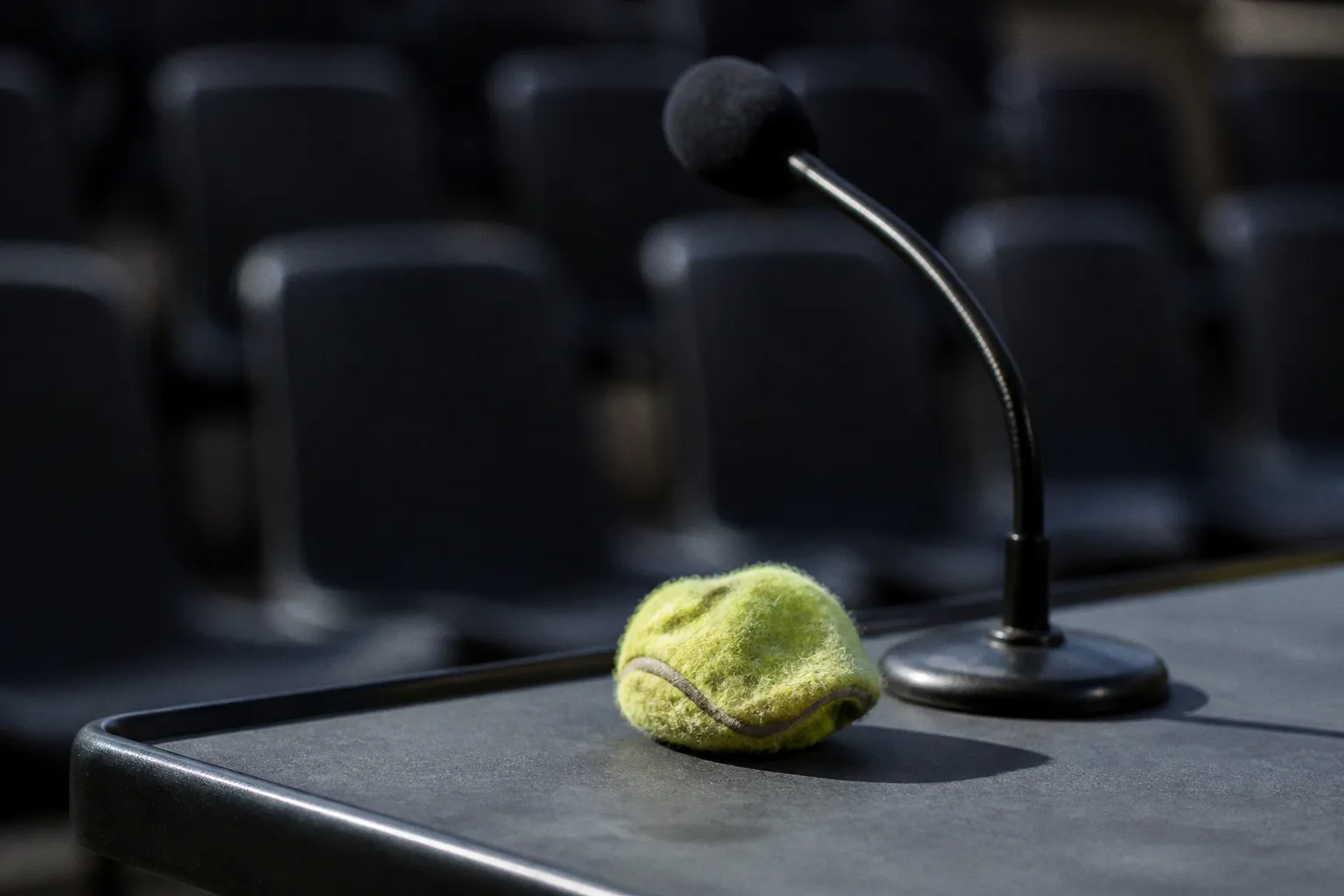
The racket is still warm in the hand, the body is carrying the friction of a long match, and the mind is trying to separate the last unforced error from the next tactical adjustment—yet the professional obligation is already waiting beyond the locker room. Under Grand Slam rules, players are required to attend post-match media conferences unless they have reasonable grounds, such as documented illness or injury, for being unable to appear.
That obligation is often described as part of the business of tennis, and it is. Tournaments sell access, broadcasters need material, sponsors depend on visibility, and fans want to hear from the people whose bodies and decisions have shaped the match. But the commercial logic does not erase the psychological reality. A player may be required to explain a defeat at precisely the moment when concentration has collapsed, adrenaline is still high, and every answer feels exposed to interpretation.
This is the central tension in tennis press conference psychology and media pressure: the player is expected to be both physically spent and publicly available, both emotionally honest and strategically controlled.
The contractual burden: rules, fines, and professional obligation
Professional tennis has never treated the press conference as a casual courtesy. It is built into the tournament structure, alongside match scheduling, court access, official ceremonies, and other obligations that make the sport visible beyond the lines of the court. The Grand Slam tournaments have made clear that a player who skips a mandatory post-match media appearance can face financial penalties, and repeated violations can lead to more severe Code of Conduct consequences.
The basic rule is straightforward. After a match, players are expected to attend the designated media session unless they are unable to do so on reasonable grounds. The wording matters because it leaves room for illness and injury, but not for the ordinary emotional pain of losing, however severe that pain may feel in the moment. The system recognizes physical incapacity more readily than psychological overload—an imbalance that has become increasingly difficult to ignore.
Naomi Osaka’s experience at the 2021 French Open made this conflict visible to an audience far beyond tennis. After defeating Patricia Maria Tig in the first round, Osaka skipped her mandatory post-match press conference and was fined $15,000. The four Grand Slam tournaments jointly warned that continued violations could bring further Code of Conduct sanctions, including default from a tournament and investigations into major offences that might affect future participation.
Osaka later withdrew from the tournament voluntarily. She was not permanently banned, and she was not defaulted from Roland Garros as a direct consequence of that first skipped press conference. But the episode changed the language around media duty. What had usually been handled as a minor administrative infraction became a public debate about mental welfare, institutional power, and the limits of a player’s availability.
The rules have not disappeared. The requirement remains part of the professional environment, and the financial consequences are not symbolic. They establish a hierarchy: the tournament has a product to protect, and the player’s willingness to participate in the media operation is treated as one of the conditions of entering that product.
A press conference is not physically part of the match, but for the player it can be the final set of the day—played under a different kind of scrutiny.
The difficult question is not whether tournaments need media access. They do. The more precise question is whether a single format—one player, one microphone, a room of reporters, immediate questions after victory or defeat—can serve every athlete, every match, and every mental state.
The vulnerability gap after a tennis match
A tennis player does not leave the court in a neutral condition. Even a relatively short match can involve repeated surges of tension, constant visual calculation, and a level of physical expenditure that changes how the brain receives information. After a three-set battle, the player may be dehydrated, overheated, disappointed, euphoric, or still caught inside the narrow tactical world of the match.
This is where athlete press conference anxiety becomes distinct from ordinary public speaking. The player is not simply nervous about being seen. They are being asked to translate an intensely private physical experience into language while the result is still raw and the consequences of the answer are uncertain.
A post-match question may sound simple: Why did the match turn? What happened on the important points? Were you injured? Did the opponent surprise you? But each question can open several risks at once.
- A tactical explanation can reveal information to future opponents or confirm an opponent’s successful pattern.
- A candid answer about pain can invite speculation about fitness, preparation, or withdrawal.
- Anger can be interpreted as disrespect, while restraint can be described as evasiveness.
- A sentence about coaching, scheduling, or officials may become a larger story than the match itself.
- An answer given in exhaustion can remain online long after the player has had time to reconsider it.
The press room therefore creates a vulnerability gap. Reporters may be seeking clarity, but the player is often operating with reduced emotional and physical reserve. The athlete’s public role demands precision at the moment when precision is hardest to maintain.
This does not mean that players should be insulated from difficult questions. Tennis depends on accountability, and its most compelling rivalries are often understood through the players’ own explanations of pressure, tactics, and conflict. The problem is less the existence of questioning than the assumption that immediate access always produces the best form of truth.
A player who has just lost a Grand Slam match may still be processing a late change in court position, a missed forehand at 5–4, or the strange atmospheric density of a heavy evening session. The press conference asks for a finished narrative before the experience has settled into one. That is why answers can become repetitive or guarded—not necessarily because the player has nothing to say, but because the mind has not yet found a stable order for what happened.
Tennis player media training—and its limits
Media training gives players a vocabulary for surviving this environment. They learn to distinguish between a question that deserves a direct technical answer and one that contains a premise they do not accept. They practice slowing the rhythm of a response, avoiding unnecessary speculation, and returning to a central point without sounding as though they are reciting a prepared statement.
The strongest training does not turn athletes into polished machines. It helps them preserve judgment when the room is asking for immediacy. A player may need to say that they do not yet know why a match changed, that they will review the situation with their team, or that they do not want to discuss a private matter. Those are not evasions when they accurately describe the player’s position.
Still, media training has a boundary. It can improve technique, but it cannot remove the emotional cost of being questioned after a painful defeat. Nor can it guarantee that a hostile question will remain only a professional inconvenience. Some questions are designed to test composure, and others carry assumptions about personality, ambition, nationality, coaching, or perceived failure.
Handling hostile questions requires more than a memorized phrase. It requires the player to recognize what is being asked beneath the wording. Is the reporter seeking a tactical explanation, a conflict narrative, an admission of blame, or an emotional reaction? The answer may need to address the legitimate part of the question while declining the bait.
That balance is particularly difficult for young players and for athletes whose public identities have become larger than their match results. A champion is often expected to speak as a representative of excellence even after a defeat. A rising player may be asked to explain a collapse as though it reveals a permanent weakness. A veteran may be questioned about retirement, injuries, or relevance when they are still thinking about one missed return game.
The press conference does not merely document a career. It participates in constructing the story of that career.
The difference between explanation and confession
Tennis journalism is at its best when it asks players to illuminate the match rather than confess to a character flaw. The distinction is subtle but essential.
An explanation considers conditions: ball height, court speed, serve location, return depth, fatigue, momentum, wind, or the opponent’s change of pattern. A confession is often framed around inadequacy: Why did you choke? Why did you lose control? Why are you still struggling with this?
The first approach respects tennis as a physical and tactical discipline. The second reduces a complicated performance to a psychological accusation. Players do not always receive that distinction in the room, and they are not obliged to accept the premise simply because it has been put into a microphone.
A useful answer may be brief, but it should be accurate. The player can acknowledge that the opponent played better without pretending to understand every cause immediately. They can accept responsibility without converting a single defeat into a verdict on their identity. That is a form of professional self-preservation, not public relations in the shallow sense.
From Osaka to Sabalenka: the evolution of player resistance
Naomi Osaka’s 2021 boycott was not the first sign that media obligations could become a site of conflict. Venus Williams was fined $5,000 after skipping her mandatory press conference at the 2016 Australian Open following a first-round loss to Johanna Konta. The difference was not simply the amount of the penalty or the player involved. By 2021, the conversation around mental health had become more public, and the expectation that athletes should quietly absorb every demand of the sports economy had weakened.
Osaka’s decision forced tennis to confront an uncomfortable contradiction. The sport wanted players to be accessible as personalities, but it had not fully considered what happens when that accessibility becomes psychologically costly. It also exposed the unevenness of the existing framework: the rules were clear about attendance, while the boundaries of mental welfare were far less clear.
The response from tournament authorities emphasized the importance of media obligations and the consequences of non-compliance. From the institutions’ perspective, this was understandable. A Grand Slam tournament is not only a competition; it is a global broadcast, a commercial calendar event, and a network of commitments to media organizations and partners. Removing the press conference entirely would have consequences for the way the sport reaches its audience.
But the incident also gave players a new language of collective resistance. Rather than treating media discomfort as an individual weakness, athletes began to frame it as a structural issue involving scheduling, revenue distribution, working conditions, and mental welfare.
In May 2026, top players including world No. 1 Aryna Sabalenka took part in a coordinated action during Roland Garros, limiting press conference duties to 15 minutes in protest against concerns about revenue distribution and player welfare. This was different from simply refusing to appear. The players entered the media space but challenged its duration and terms.
That distinction matters. A boycott says the existing arrangement is unacceptable. A time limit says the obligation may be legitimate, but the current scale of the demand is not. It is a negotiation conducted in public, with the player’s body and reputation still serving as the currency of the tournament.
The 15-minute limit also reveals a practical truth about media rooms. The quality of an interview does not necessarily increase with its length. A player who has had time to cool down, recover, and organize their thoughts may provide more useful analysis in a shorter session than an exhausted athlete kept under questioning until the answers become defensive or incoherent.
The protest did not abolish mandatory post-match press conferences. That remains important: the rules still require media duties, and tournaments retain the ability to issue penalties. Yet the nature of the dispute has shifted. Players are no longer arguing only that a particular question was unfair. They are asking who controls the conditions under which the question is asked.
The financial stakes of silence
The penalty scale makes the conflict tangible. A skipped press conference is not treated as a private choice with a private consequence. It becomes a line item in a player’s professional record, and the amount can vary according to the governing rules and tournament provisions.
| Situation | Documented consequence or rule |
|---|---|
| Venus Williams, 2016 Australian Open | $5,000 fine after missing a mandatory press conference following a first-round loss |
| Naomi Osaka, 2021 French Open | $15,000 fine after skipping the press conference following her first-round victory |
| General Grand Slam rule provisions | Fines of up to $20,000 per violation |
| Specific tournament provisions | Potential maximum fines of up to $50,000 |
| Repeated violations | Possible Code of Conduct sanctions, including tournament default and major-offence investigations that may lead to future suspension |
The progression from $5,000 to $15,000 is not, by itself, a measurement of psychological harm. A fine is an administrative instrument, not a clinical assessment. Its purpose is to enforce compliance and communicate the value placed on media access. But the financial threat changes the emotional texture of the obligation. Players are not only deciding whether they can face a room of questions; they are calculating the cost of protecting themselves from that room.
For lower-ranked players, the pressure may be sharper because prize money, travel costs, coaching expenses, and ranking points are tightly connected to tournament participation. For elite players, a fine may be financially absorbable, but the institutional warning is still significant. Repeated refusal can affect access, reputation, and future disciplinary proceedings.
There is also an important difference between silence and withdrawal. A player may skip one appearance and accept a fine. They may comply while saying very little. They may leave a tournament altogether, as Osaka did voluntarily after the 2021 French Open controversy. Each option carries a different relationship to the rules, the press, and the player’s own capacity.
The sport’s current structure tends to treat these choices as disciplinary questions. Yet a player’s decision to avoid a press conference can contain several motives at once: anxiety, exhaustion, fear of being misunderstood, anger at the framing of a question, a wish to protect family or team members, or a broader objection to the way the tour distributes attention and money. The rule can identify the missed duty. It cannot fully explain the human reason behind it.
The fine has a number attached to it; the pressure does not. That is where the rulebook becomes less precise than the life of a player.
Can tennis balance commercial needs and mental welfare?
Tennis does need a media system. The sport’s history is carried not only by scores but by explanations—by the way champions describe pressure, the way rivals speak about one another, and the way a player’s account can reveal the tactical meaning hidden inside a result. Press conferences allow audiences to move closer to the court’s actual texture. They can clarify whether a match turned on return position, fatigue, wind, nerves, or a tactical decision that was invisible from the stands.
The answer, then, is unlikely to be a complete separation between players and media. It is more likely to be a redesign of the encounter.
Several changes would preserve access while reducing unnecessary strain:
- A short recovery window could be built into the schedule before the formal session, particularly after long or physically demanding matches.
- Tournament media teams could distinguish between essential post-match obligations and extended availability for feature interviews.
- Players could have a clearer process for requesting a modified session when illness, injury, or acute distress makes a standard conference unreasonable.
- Questions could be directed toward the match before being pushed toward personal conflict, coaching speculation, or identity-based narratives.
- A time limit could become a normal professional boundary rather than an act of protest.
- Media training could be offered as continuing support, not merely as preparation for a sponsor-facing career.
None of these measures would make difficult questions disappear. They would acknowledge that access has a physical setting and a human cost. The room has temperature, fatigue, fluorescent light, waiting reporters, cameras, and the knowledge that every pause may be interpreted. These material details are not incidental. They shape the quality of the conversation.
The psychological burden also changes across a player’s career. A teenager entering the tour may be overwhelmed by the sudden conversion of private disappointment into public content. A champion may become exhausted by the expectation to provide the same emotional availability after every victory. A veteran returning from injury may face questions that are not really about the match at all, but about whether the player still belongs at the highest level.
The culture of the locker room is part of this story. Players observe who is punished, who is praised for candour, who is criticized for refusing a premise, and who is allowed to leave the room without the incident becoming the headline. These patterns teach athletes what kind of vulnerability is safe. They also influence whether players see the press conference as an extension of the sport or as a separate test imposed by the institutions around it.
For the media, the challenge is not to become gentler in the vague sense. It is to become more exact. A precise question about a second-serve pattern may be more demanding—and more revealing—than a broad question about confidence. A careful question about a coaching change may produce more insight than an invitation to discuss locker-room drama. Respect for the player does not require softness. It requires understanding what the player has actually done, and what the evidence of the match can support.
The player’s final set
The post-match press conference is often treated as the epilogue to tennis, but it is part of the event itself. It extends the match into another arena where control is less visible and where the player’s words can influence the meaning of what has just happened. A champion may use the room to set the terms of a rivalry. A defeated player may protect a fragile rebuilding process. A young athlete may learn, in public, how much of the self can safely be offered to the sport.
The rules provide a necessary structure, but structure is not the same as wisdom. Mandatory media duty can support the commercial life of tennis while still requiring reform in the way it is timed, conducted, and enforced. Osaka’s fine, Williams’s earlier penalty, and the 2026 player protest all belong to the same history: a gradual recognition that access to athletes is not weightless.
The best future for tennis press conferences will not be one in which players are shielded from every uncomfortable question. It will be one in which the sport understands the difference between accountability and extraction. Players should explain their tennis when they can, challenge unfair premises when they must, and retain some authority over the boundary between professional performance and personal exposure.
After all, the match does not end when the scoreboard changes. It ends when the player has had enough time to return from the intensity of the court—and when the conversation that follows treats that return as part of the reality of the sport.