Suzanne Lenglen and the 1919 Wimbledon Final That Changed Everything
Eight thousand bodies crammed into a venue built for thirty-five hundred, watching a twenty-year-old Frenchwoman in a calf-length dress and bare forearms dismantle forty years of British sporting tradition. July 1919 at Worple Road wasn't a tennis match. It was a hostile negotiation between centuries, and the twentieth century won by the narrowest of margins: 10–8, 4–6, 9–7.
Suzanne Lenglen didn't arrive at Wimbledon to make friends. She arrived to collect what the Great War had deferred — a title vacated by four years of trench warfare and a champion, Dorothea Lambert Chambers, who held the 1914 crown and hadn't played a defence of it since. The narrative practically writes itself: youth versus experience, modernity versus tradition, France versus England. And that's precisely the problem with how most people remember this match. It's been flattened into a fairy tale. The reality was far more psychologically brutal than that.
The Clash of Eras: Modernity in Calf-Length Fabric
Start with what people actually saw from the stands — not the tennis, but the bodies playing it. Lambert Chambers appeared in the full regalia expected of a Wimbledon champion in 1919: corsets, long sleeves, a skirt that reached the ground. Forty years old, seven titles to her name, the very architecture of women's tennis shaped in her image. She was the establishment, and she dressed the part.
Lenglen walked out in something that scandalised traditionalists to their bones. Bare forearms. Short sleeves. A dress that terminated at the calf. To the sensibilities of 1919, this was less a fashion choice than a provocation — a deliberate visual statement that the old order's rules of propriety did not apply to her. And that's before she hit a ball.
The psychological friction here is what matters. Lambert Chambers wasn't just defending a title; she was defending an entire conception of what women's tennis should look like, how it should behave, who it should belong to. Lenglen, six months removed from the war that had frozen the sport's competitive hierarchy, represented everything that era could not contain. The cognitive load of playing across the net from that — from someone who embodied the dismantling of your world — is not something any scoreboard can quantify.
Lambert Chambers brought seven Wimbledon titles and a century's worth of decorum. Lenglen brought bare arms, a flask of cognac, and absolutely no reverence for either.
The 44-Game Marathon: Attrition at Worple Road
The scoreline alone — 10–8, 4–6, 9–7 — tells you this was a war of attrition, not a coronation. Forty-four games in a women's singles final. That set a Wimbledon record that stood for fifty-one years, not broken until 1970. Think about that durability. The Open Era was already underway before anyone played more games in a women's final than Lenglen and Lambert Chambers did on that July day in south-west London.
The first set went to 10–8. That's not a comfortable margin; it's a set that could have gone either way, a set where every game past 8-all felt like a coin toss weighted by whoever was holding serve with slightly less panic. Lambert Chambers took the second set 6–4, and at that point the match pivoted. The narrative shifted. The older champion had levelled, had demonstrated that Lenglen's youth and flash could be neutralised by precision and patience.
Then the third set reached 6–5 Lambert Chambers. She served at 40–15. Two match points.
Let that sit for a moment. Two match points for a seven-time champion against a twenty-year-old playing her first Wimbledon final. The probability calculus at that moment overwhelmingly favoured Lambert Chambers. The crowd — what you could hear of it over the crush of eight thousand people in a space designed for fewer than half that — must have felt the shift coming. The old guard would hold. Tradition would survive.
It didn't.
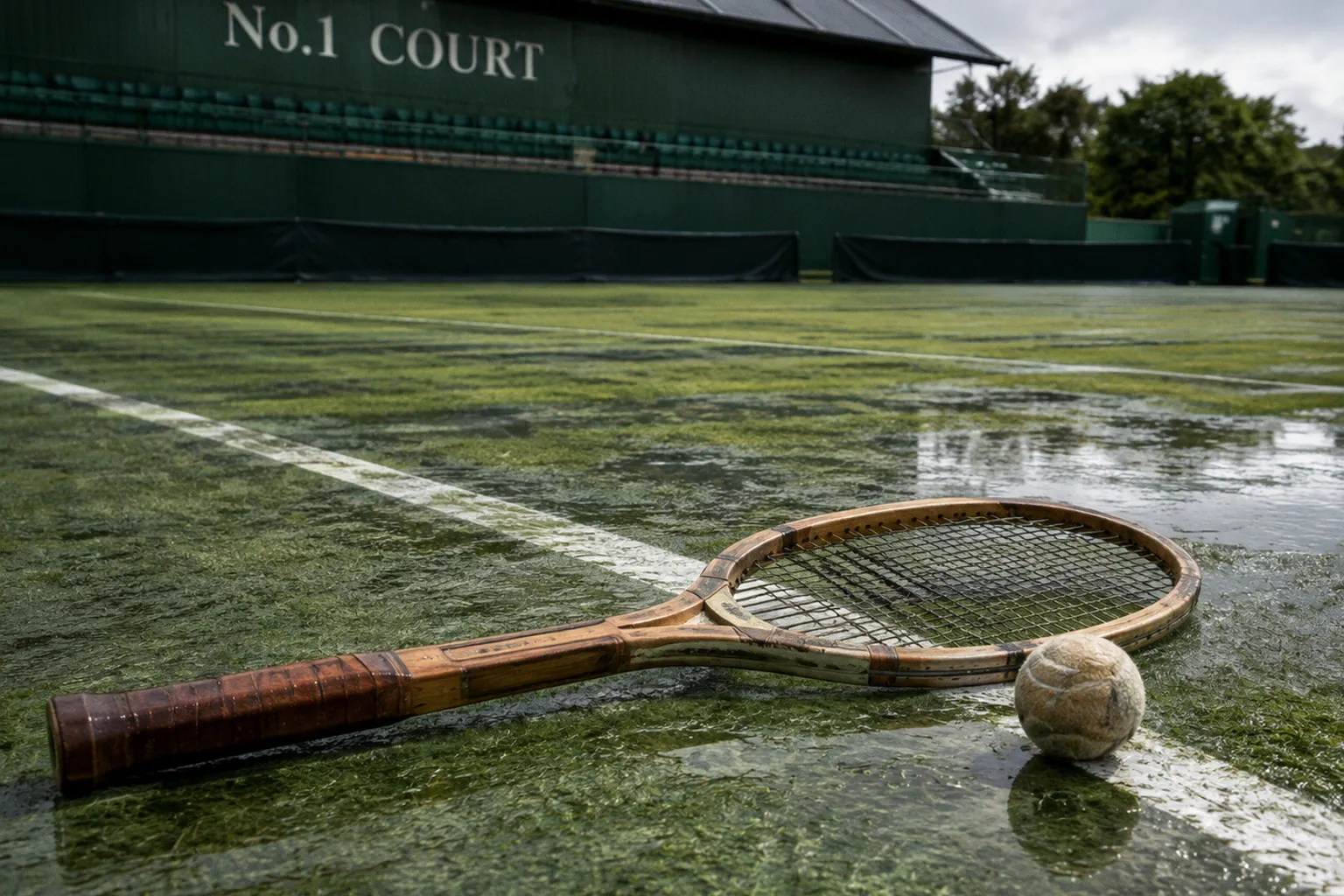
Lenglen saved the first match point on raw defiance. The second came back off the frame of her racquet — a volley, imperfect, wooden, desperate — and somehow it landed in play. She won the point. She won the game. She won the set 9–7.
Two match points saved, one off the wooden frame of a racquet, in front of eight thousand witnesses to what was supposed to be someone else's coronation.
That frame shot is the moment worth preserving in memory, not because it was beautiful — it almost certainly wasn't — but because it exposes the anatomy of a collapse. Lambert Chambers did everything right. She earned her match points. She played the percentages. And she lost because her opponent's reflexes were faster than probability, because a wooden frame sent a ball back over the net when physics and logic said it shouldn't have. That's not a fairy tale. That's the specific cruelty of competitive sport: you can do everything correctly and still have the match ripped from your hands by a mis-hit volley.
Cognac and Courage: The Pharmacology of Nerve
Somewhere during the third set, a bottle was handed down from the stands to Suzanne Lenglen. She sipped from it between points. It contained cognac.
This detail has been romanticised beyond all recognition. The popular version — plucky young Frenchwoman takes a sip of brandy to steady her nerves, how charming, how very French — strips the moment of its actual psychological significance. Lenglen wasn't performing theatre. She was managing her physiological state under extraordinary physical and emotional duress in front of a hostile crowd that had come to watch her lose.
The cognac was a tactical intervention. Alcohol in small doses can temporarily reduce the physiological symptoms of acute anxiety — the shaking hands, the tightness in the chest, the narrowing of peripheral vision that comes with fight-or-flight. In 1919, sports psychology as a formal discipline didn't exist. Athletes self-medicated with whatever worked. Lenglen, or whoever advised her from the stands, understood that the third set wasn't just a tennis problem anymore. It was a nervous system problem. And they solved it with what was available.
Compare that to Lambert Chambers' approach: disciplined, proper, playing within the expected parameters of a champion. No interventions, no breaks from convention. The cognitive contrast between the two players in that third set is stark. Lenglen was operating with a toolkit — psychological, physical, pharmacological — that her opponent either wouldn't or couldn't access. The establishment champion played establishment tennis. The interloper used every advantage she could find.
That's not charming. That's strategically ruthless. And it's one of the reasons Lenglen dominated women's tennis for the next seven years.
Breaking Point: How the Crowd Broke Worple Road
Eight thousand spectators showed up. The Worple Road grounds held roughly thirty-five hundred. The arithmetic is simple and the result was chaos — people standing in aisles, crowding railings, pressing forward to see a match that had become the most anticipated Wimbledon final in a generation. Not because of the tennis, necessarily, but because of what it represented: the first Wimbledon after the war, a French challenger against the English champion, and the intoxicating possibility that the old order might actually fall.
The All England Club took notes. The logistical failure of 1919 — the overcrowding, the safety concerns, the sheer inadequacy of the Worple Road facilities for the appetite the sport had generated — became the catalyst for one of the most consequential infrastructure decisions in tennis history. Three years later, in 1922, the club opened its new home on Church Road. A larger venue, purpose-built for the crowds that Lenglen's star power and the post-war hunger for spectacle had proven would come.
Lenglen didn't just win a tennis match in 1919. She made Worple Road obsolete. The old grounds simply could not contain what women's tennis had become, what Lenglen specifically had made it — an event that demanded a bigger stage. The move to Church Road is usually discussed in architectural terms, as a natural evolution of the Championships. But it wasn't natural. It was forced. Forced by a third set that lasted twenty-one games, by a crowd that doubled the venue's capacity, by a twenty-year-old whose presence made the old infrastructure feel like a relic.
The Frame-Shot Save and the Architecture of Tennis Lore
Why does this match endure? Not because of the scoreline — 44 games is impressive but not legible in the way a 70–68 final set would be. Not because of the cognac alone, though that detail certainly helps. The 1919 final persists in tennis memory because it contains the single most psychologically loaded image in the sport's early history: a young woman, two points from defeat, volleying a match-saving shot off the wooden frame of her racquet, in front of a crowd that was never supposed to fit in the building.
That image carries everything — the desperation, the imperfection, the refusal to let probability have the final word. It's not a graceful shot. It's not a shot anyone practises. It's the kind of moment that only exists under the specific cognitive pressure of being two points from losing a match you believe you should win. Lambert Chambers had to watch a frame-shot volley undo fifty-one games of meticulous, championship-level tennis. The psychic damage of that — of doing everything right and losing to a mishit — is the kind of thing that doesn't fade from a sport's collective memory.
The frame shot didn't just save a match. It established the narrative template for every improbable save that followed — imperfect, desperate, and utterly indelible.
Lenglen went on to win six consecutive Wimbledon titles. She became the first global tennis celebrity, the athlete whose name alone could fill stadiums. But all of that — the dominance, the fame, the mythology — traces back to a July afternoon at Worple Road where a twenty-year-old in a scandalous dress sipped cognac between points, saved two match points off her racquet frame, and broke the venue so thoroughly that they had to build a new one.
The 1919 final is tennis lore at its most potent: not because it was the best match ever played, but because it contained every element of human competition that actually matters — the psychological attrition, the refusal to accept the likely outcome, the physical evidence of desperation, and the institutional consequences that reshaped the sport's landscape. Lambert Chambers lost more than a title that day. She lost the argument that tradition alone could hold the future at bay.
Forty-four games, one frame shot, and a bottle of cognac. That's the whole story. The rest is just what came after.