The court may look like a uniform field of red, but its playing character depends on moisture moving through those layers—and on what that moisture does to the ball.
That is why red clay court moisture levels and ball bounce are inseparable. A damp court can soften underfoot and load the felt with water and fine clay, leaving the ball heavier and its bounce lower and less lively. In hot, dry conditions, moisture disappears quickly; the surface firms, friction changes, and the ball comes through faster with a higher bounce. The adjustment is not cosmetic. It reaches into the timing of every exchange.
The anatomy of the red surface
Professional red clay is not ordinary clay soil. At Roland Garros, the visible brick dust is a very shallow playing layer laid over a deep, carefully built base of mineral materials. That construction gives the surface its familiar color and texture, but it also makes maintenance a matter of managing a system rather than simply wetting the top.
Water in the surface affects how the top layer binds and how the ball interacts with it. When the court is damp, the red dust and the layer beneath it become softer. The ball meets more yielding ground, while its felt picks up moisture and clay particles. When the surface dries, it firms; the sliding player encounters different friction, and the bounce becomes more pronounced.
This helps explain why clay can feel like several surfaces over the course of a day. The court’s composition does not change, but its moisture does. A morning court, a court after watering, and one exposed to afternoon heat may offer distinct conditions, even within the same tournament and on the same grounds.
Court maintenance, then, is not an attempt to make every hour identical. It is a way to keep the surface within a playable range, balancing grip, slide, and bounce as the weather shifts. That balance is delicate: too much water can leave the ball heavy and the court soft; too little can harden the surface and alter the pace.
The physics of the heavy ball
The ball itself begins within a defined standard. Under ITF regulations, an approved tennis ball weighs between 56.0 and 59.4 grams. Its bounce is also tested: dropped from 254 centimeters onto a smooth, rigid surface, it must rebound to between 135 and 147 centimeters.
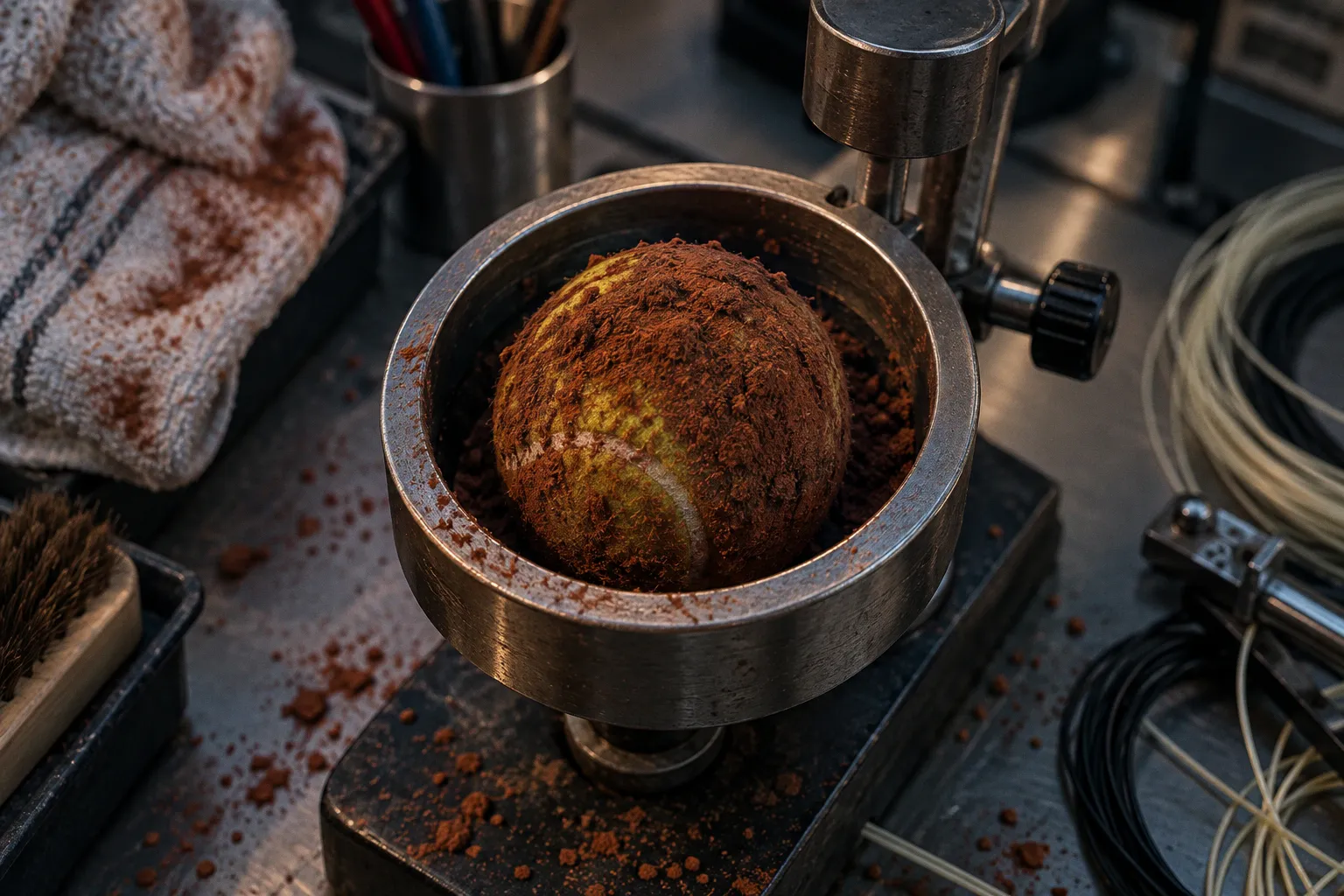
Those specifications provide a controlled baseline. A match on clay does not take place on a smooth, rigid test surface, however, and the ball’s felt is exposed to the conditions around it. In humid air or on wet clay, the felt absorbs moisture and gathers red debris. The result is a ball that feels heavier and moves more slowly through the air, while its contact with the soft court produces a lower, less lively bounce.
There is no single useful number for how much weight a ball gains during a match. The increase depends on conditions, and a precise percentage should not be assumed. What matters to the player is the changing response: the ball can lose some of its quickness, sit differently after the bounce, and demand more effort to push through the court.
On damp clay, the ball carries the conditions with it: moisture in the felt, grit on the surface, and less lift off the bounce.
That change can alter the rhythm of a rally. A player who expects the ball to spring away may find it arriving lower and slower. The extra time can invite a more patient construction of the point, but the heavier ball is not automatically easier to attack; it may be harder to accelerate, and the soft surface can absorb some of the force that would otherwise make a shot rush through.
This is the practical answer to how humidity affects tennis ball speed. Humid air and wet conditions contribute to a heavier, slower ball, but the court and the ball are working together. The felt collects moisture and clay, while the damp surface changes the bounce. Treating either effect in isolation misses the feel of the exchange.
Evaporation, friction, and heat
Dry heat moves the court in the opposite direction. As surface moisture evaporates, red clay firms and the conditions become faster. The reduced moisture changes the friction available to a sliding player, while the ball tends to rebound higher and more lively than it does from a damp surface.
During heatwaves, court surface temperatures have been recorded reaching 35°C. At that level, evaporation can be rapid enough to make the day’s surface character change noticeably. The visible color may remain the same, but the material beneath a player’s shoes has lost moisture, and the bounce reflects that loss.
The distinction between air temperature and court surface temperature matters. Players experience both, but the surface itself is in direct contact with the ball and with their movement. A hot, dry court can feel firmer and less forgiving under a slide; a damp court gives more, and the ball does not jump away in the same fashion.
These shifts have tactical consequences without neatly favoring one style. A higher bounce may give a player more room to work with spin, while faster conditions can reward earlier contact and direct acceleration. A slower, heavier ball can extend rallies, but its weight may make it harder to redirect sharply. The court does not hand one player a strategy—it changes the cost and timing of each choice.
The grounds crew’s measure of moisture
At Roland Garros, grounds crews manage moisture with direct, practical judgment. After play, they assess the court by hand, feeling the surface rather than relying on electronic sensor systems to dictate watering. That detail says something about the material: the same court can respond differently depending on recent weather, shade, play, and the condition of its layers.
Evening watering helps recharge moisture beneath the playing surface. In extreme heat, crews may also apply calcium chloride to help retain dampness. These are not merely housekeeping routines. They are part of maintaining the balance between a court that is too soft and one that has dried into a harder, faster surface.
Clay court surface maintenance is therefore less like setting a fixed dial and more like reading a living material. Watering has to account for what the court has already absorbed and what the weather is likely to take away. A crew’s assessment joins the practical signs underfoot to the broader conditions of the day: temperature, humidity, and the surface’s response to play.
For spectators, the result can look subtle. There may be no dramatic change in color or texture from one set to the next. Yet the ball’s path can tell the story: a lower, heavier rebound after damp conditions; a firmer, livelier response as heat dries the surface. Players read those signs quickly because their timing depends on them.
Rain, preparation, and the changing match
The impact of rain on clay court play is not simply that the match stops. Wet conditions can soften the surface and add moisture to the ball’s felt, changing both pace through the air and height off the court. Once play resumes, the surface may still carry a different balance from the one players faced before the interruption.
That is why tennis court surface preparation matters after weather changes. The grounds team has to judge not only whether the court is playable, but whether its moisture is even enough for predictable movement and bounce. Red clay drainage systems and the deep foundation are part of that broader conversation, but drainage alone cannot make every condition uniform. The top layer, the material beneath it, and the ball all respond on their own timescales.
A player returning to a damp court may need to allow for a ball that does not kick as expected and that takes more effort to drive. On a drying court, the same rally can demand earlier preparation, because the ball may rebound higher and move on more quickly. Neither adjustment is dramatic in isolation. Across a long exchange, however, small differences in height, speed, and slide accumulate into a different match.
The most useful way to watch clay is to look beyond the red. Notice whether the surface appears dark and damp or pale and dry; watch how far the ball rises after the bounce, and whether it seems to sit or spring. Then watch the players’ spacing and preparation. They are not responding to a label like “slow court” or “fast court” so much as to the particular mixture of moisture, friction, and ball weight in front of them.
Red clay’s character is often described through patience, but patience is not built into the color. It emerges from physical conditions that can shift with humidity, rain, and heat. At Roland Garros, a thin layer of brick dust over a deep foundation becomes a different playing surface as water moves through it—and the ball carries that change into every point.