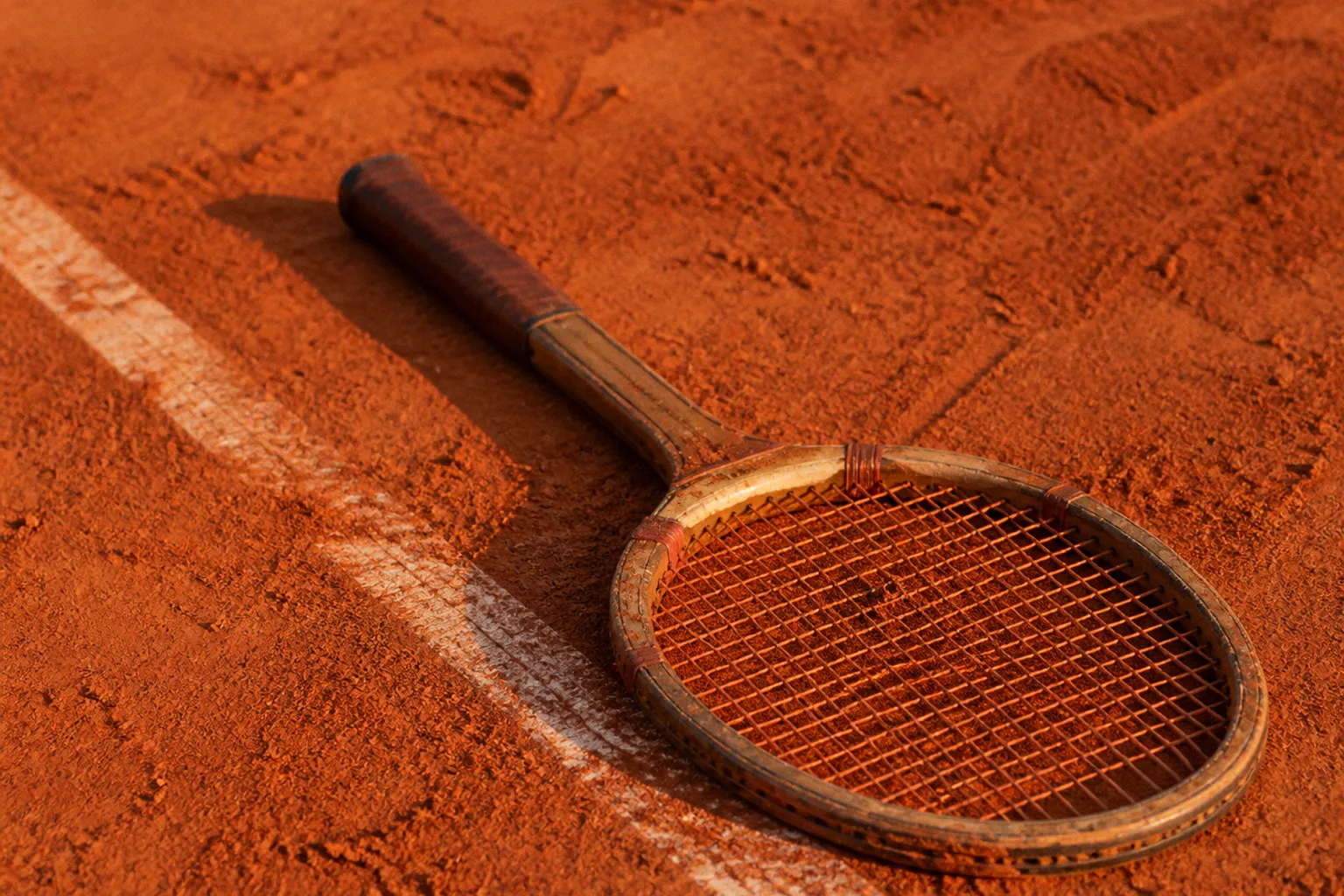
The absence did not arrive with a farewell ceremony or a final match. It appeared as a blank space in the rankings, the kind you notice sideways while scrolling through a draw sheet and wondering why every name seems to belong to the same mechanical family.
That is what makes the question of one handed backhand extinction in modern tennis so difficult to answer. The stroke has not disappeared from the sport. It has disappeared from the centre of the sport, from the place where young players look for proof that a particular way of moving through a ball can still carry them to the largest stages.
This is not simply nostalgia for a more elegant era. It is a change in the competitive grammar of tennis. The one-handed backhand history is long, rich and full of successful contradictions, but the classic stroke now has to justify its existence in conditions that were not designed around it.
The 1973 Baseline: When the One-Hander Was the Standard
When the ATP rankings began in 1973, the one-handed backhand was still the conventional model at the top of the men's game. It was not necessarily considered more beautiful, though it often looked that way. It was simply what most players had been taught, what most coaches understood, and what the equipment and playing conditions made comparatively practical.
The two-handed backhand was already present. Chris Evert and Jimmy Connors helped make it visible and successful in the late 1960s and early 1970s, at a time when some coaches still regarded the second hand as a crutch rather than a weapon. Connors in particular made the two-hander impossible to dismiss: compact, early, flat through the court and perfectly suited to taking the ball before it could rise into a comfortable strike zone. Björn Borg also built his defining backhand around two hands, using heavy topspin and immense control rather than the classical single-handed release.
That correction matters because the history is often tidied into a parade of one-handed heroes, with every great player from the period placed on the same side of the divide. The real story was more interesting. The sport already contained two competing answers to the backhand question. Connors and Borg demonstrated that a two-handed stroke could be not merely defensive but forceful, repeatable and central to a championship game. Their success did not immediately end the one-hander, but it gave the alternative a public language.
The one-handed tradition still had extraordinary representatives. Rod Laver's left-handed topspin drive, Arthur Ashe's compact control, John Newcombe's classical preparation and Guillermo Vilas's heavy lefty roll belonged to different tactical worlds, yet they shared the same basic freedom: the dominant arm could extend fully through contact, and the player could change the shape of the point with slice, drive or approach in a single motion.
Then came the late 1970s and 1980s. John McEnroe turned the backhand into an extension of his movement to the net. Ivan Lendl showed how a powerful baseline game could be built around a technically demanding stroke. Boris Becker and Stefan Edberg used the one-hander within attacking systems that asked the player to move forward rather than live permanently behind the baseline. Pete Sampras made the slice, the block and the occasional drive part of a larger serve-led architecture.
The one-hander survived because it offered more than a way to return a hard ball. It offered variation. A player could carve the ball low, take pace away, change the height of an exchange, or approach behind a shot that forced the opponent to hit from an uncomfortable position. On faster courts, where points were shorter and the bounce lower, those options were not decorative. They were practical.
The equipment also mattered. Wooden rackets and earlier generations of lighter or less powerful frames did not produce the same combination of speed, spin and rebound that modern players face. A backhand was still difficult, but the incoming ball did not carry quite the same relentless weight. The old stroke had room to breathe.
The Great Disappearance: Mapping the 2024 Top-10 Void
The change did not happen in a single season. It accumulated through several generations of players who grew up with a different technical default.
By late 2024, the ATP top 100 contained only a small group of one-handed backhand players, commonly identified as Grigor Dimitrov, Stefanos Tsitsipas, Lorenzo Musetti, Giovanni Mpetshi Perricard, Denis Shapovalov, Christopher O'Connell, Dušan Lajović and Daniel Altmaier. They do not all use the stroke in the same way, and their careers do not carry the same weight, but together they form a shrinking technical minority.
| Player | Backhand identity | What the stroke gives him |
|---|---|---|
| Grigor Dimitrov | Fluid drive-and-slice combination | Variety, disguise and a natural transition to the front court |
| Stefanos Tsitsipas | Heavy attacking one-hander | Weight on the ball and a first-strike pattern when he has time |
| Lorenzo Musetti | Changeable, wrist-led creation | Angles, rhythm changes and the ability to open a point from unusual positions |
| Giovanni Mpetshi Perricard | Young power game with a one-hander | A developing attacking option behind a major serve |
| Denis Shapovalov | Left-handed, high-risk acceleration | Sudden pace and the possibility of changing direction early |
| Christopher O'Connell | Classical tour mechanics | A compact solution built around timing and positioning |
| Dušan Lajović | Veteran drive-and-slice structure | Control of tempo and comfort in longer tactical exchanges |
| Daniel Altmaier | More contained, clay-oriented use | Stability, variation and a way to disrupt baseline patterns |
Eight names do not make a species extinct. They do show how far the stroke has moved from the centre of the professional ecosystem.
The early-2024 top-ten absence was therefore significant less as a statistical curiosity than as a cultural marker. For decades, a young fan could watch the highest-ranked players and find several different versions of the one-handed backhand: a flat strike, a looping topspin ball, a stabbing slice, a compact block. In 2024, the aspiring player could watch the entire top tier and see none.
That distinction matters. Professional tennis is not only a competition between adults who have already chosen their techniques. It is also a visual education system. Players copy what they see. Coaches demonstrate what they trust. Parents become more comfortable with the stroke that appears to be winning at the highest level. Once the one-hander vanished from the top ten, its decline became self-reinforcing.
The WTA presents an even thinner picture, with only a very small number of top-ranked players using a one-handed backhand. The women's game has its own history and biomechanics, so the comparison should not be reduced to a simple mirror image of the ATP. Still, the broad direction is unmistakable: the two-hander has become the dominant competitive language across professional tennis.
The one-hander did not die in a final. It became harder to find in the places where the sport teaches its future to look.
Physics and Coaching: Why Modern Dynamics Favor Two Hands
Three forces have pushed the game in the same direction: the ball, the bounce and the demands placed on a player before the point has even become tactically interesting.
The ball arrives with more to manage
Modern strings and racket technology make it easier to produce heavy spin and high ball speed. The effect is not simply that every shot is faster. It is that the receiver has less time and more vertical movement to deal with. A ball can arrive with considerable pace, jump sharply and still carry deep into the court.
A one-handed backhand can generate topspin against that ball. Players such as Wawrinka, Tsitsipas and Musetti have shown it repeatedly. But the stroke asks for a precise relationship between the feet, the torso, the hitting shoulder and the contact point. If the player is late, cramped or forced to take the ball above the preferred strike zone, there is less structural support available at the instant of impact.
The two-hander solves part of that problem by distributing the work. The non-dominant hand helps stabilise the racket, control the face and redirect incoming pace. It gives the player more room to make a functional contact when the preparation is imperfect. That does not make the stroke effortless. It makes it more forgiving in the situations that modern tennis produces most often.
This is why the argument cannot be reduced to aesthetics. The one-hander may look freer, but it is often less forgiving when the ball is heavy and the player is under time pressure. A two-handed backhand can turn defence into a neutral ball with a smaller margin for structural collapse.
The bounce has changed the conversation
The one-hander has always had a complicated relationship with height. It can handle a high ball when the player has time to move around it, take it early or use a controlled slice. What it dislikes is not height by itself but height combined with pace, depth and repetition.
Much of modern baseline tennis is built around exactly that combination. Clay rewards the player who can keep the ball deep and high for long stretches. Hard courts demand repeated reactions to heavy balls that arrive at shoulder level or above. Even grass, once the natural home of the low-skidding one-hander, is no longer the fast, uniformly unpredictable surface it represented in the classic serve-and-volley era.
The old one-handed backhand was not only a baseline stroke. It was a bridge between phases of a point. A player could defend with slice, move forward behind a low ball and finish near the net. As the professional game became more concentrated around baseline exchanges, the value of that bridge declined. The backhand increasingly had to withstand repeated high-intensity exchanges without changing the shape of the rally.
A modern two-hander is better suited to that repetition. It can be loaded, compacted and reproduced under pressure. The one-hander can do the same for a player with exceptional timing and movement, but the technical threshold is higher.
Coaching follows the evidence, but not mechanically
The coaching question is more delicate than the familiar claim that academies have simply banned the one-hander. There is no universal rule that every junior must be redirected toward two hands, and there are coaches who continue to teach the one-hander when a player's coordination, reach, timing or tactical instincts support it.
The larger trend is still clear. In many development environments, the two-hander is the safer starting point because it gives a young player early stability and a reliable way to handle pace. Coaches can build a return, a defensive pattern and a baseline identity around it before asking more difficult questions about variation.
That creates an incentive structure rather than a conspiracy. A coach who has seen most successful modern players use two hands is likely to begin there. A federation looking for repeatable development methods may prefer a stroke that works across a wider range of bodies and playing conditions. An academy's reputation is built on producing competitive results, not on preserving every branch of tennis history. None of this means that a one-handed backhand is forbidden. It means the burden of proof has shifted.
A young player who arrives with a natural one-hander may be encouraged to experiment with two hands, especially if the existing stroke breaks down against height or pace. In some programs, that encouragement may become strong pressure. In others, the coach may preserve the one-hander and adapt the player's movement, court position and rally patterns around it. The experience depends on the coach, the country, the age of the player and the level of competition.
What has changed is the default conversation. The question is less often, “Can this player learn to make the one-hander work?” and more often, “Why accept its extra demands if the two-hander offers a clearer route?”
That is a rational question. It is also how technical traditions disappear.
The Federer Effect and the Crisis of Junior Inspiration
Roger Federer made the one-handed backhand visible to a generation that had otherwise been raised on two-handed examples. His stroke was not a museum piece. It could accelerate down the line, redirect a fast ball crosscourt, absorb pace with slice and turn a defensive position into an approach. More importantly, Federer gave the stroke a place inside the image of modern excellence.
That image has outlived the moment when it was formed. Young players still imitate Federer's preparation and finish, but imitation is not the same as inheritance. A junior can copy the shape of the swing while lacking the time, balance, anticipation and physical control that made the stroke viable at the highest level. The danger is that the visible elegance hides the invisible workload.
Federer's influence also created an uncomfortable paradox. He may have been the most persuasive advertisement for the one-hander in modern tennis, yet his success did not reverse the technical trend. Instead, it confirmed how unusual the complete package had become. The stroke worked because it was attached to extraordinary movement, anticipation, touch and court awareness. Those qualities cannot be installed simply by asking a junior to finish the racket over the shoulder.
The inspiration problem is therefore real, but it should not be exaggerated into a single-cause explanation. Children do not abandon a shot only because no top-ten player uses it. They also respond to what feels stable in their own bodies, what their coach can explain, what their opponents expose and what the sport rewards at their current level.
Still, visibility matters. A young player considering a one-hander needs to see more than beautiful highlights. They need to see someone survive the ugly moments: the high return to the backhand, the late contact, the ball that kicks into the ribs, the long exchange played under pressure. The modern tour offers fewer examples of that complete survival than it once did.
The crisis is not that young players cannot admire the one-hander. It is that they see fewer reasons to trust it.
The question of identity enters here. A one-handed backhand asks a player to accept a particular kind of exposure. The stroke is often more expressive than the two-hander, but its errors are also more legible. A shank, a late slice or a ball that floats short can look like a technical confession. The player cannot always hide behind compactness and repetition.
That psychological cost is not universal, but it is part of the calculation. When a match becomes physically heavy, the one-hander can make fatigue visible through the shoulder, the spacing and the quality of the contact. A two-hander often conceals the same fatigue more effectively. It gives the player another point of support and a simpler emergency solution.
The Last Eight: Can the One-Hander Find a Future?
Here is the uncomfortable question for the romantics: should the one-handed backhand survive?
The answer depends on what survival means. If it means returning to the default position it occupied in the 1970s, the evidence is poor. If it means remaining a viable path for unusual, technically gifted and tactically committed players, then the stroke is not in immediate danger.
Stan Wawrinka demonstrated that a one-hander could still be the centre of a major-winning game. His backhand was not a concession to tradition. It was a source of pressure, capable of absorbing pace and producing one of the most dangerous down-the-line shots of his generation. Federer made the stroke part of an all-court system. Dimitrov has used it as a signature of variety and improvisation. Tsitsipas has built major stretches of his attacking game around taking the ball early and driving through the court. Musetti treats the stroke as part of a broader vocabulary of changes in height, speed and direction.
These players do not prove that everyone should be taught a one-hander. They prove something more useful: the stroke is not a single tactical object. Its success depends on the rest of the player's design.
A one-hander is more plausible when several conditions line up:
- The player has reliable spacing and can reach the ball without constantly crowding the contact point.
- The return position is chosen with the stroke in mind rather than copied from a two-handed baseliner.
- Slice is treated as a tactical shot, not as an emergency escape from every difficult ball.
- The player has enough variety to prevent opponents from repeatedly attacking the same high contact zone.
- The serve, forehand and movement can create first-strike situations instead of forcing the backhand to survive every exchange.
- The coach understands how to develop the stroke without trying to make it imitate a two-hander.
That last point is crucial. Many one-handed backhands fail not because the idea is impossible but because the player is asked to use it in a game built for somebody else. A player who stands too far back, accepts high balls passively and tries to win every exchange with a full-blooded drive is volunteering for the stroke's most difficult conditions.
The future of the one-handed backhand may therefore belong to specialists. Not specialists in the narrow sense of players who can hit a pretty shot, but players whose entire tactical identity gives the shot a reason to exist. The backhand may need to be connected to an aggressive return, a strong serve, an ability to take the ball early, a willingness to change height and a credible move forward. Without those supporting structures, the one-hander is asked to do a job it was never designed to perform alone.
This is where the phrase “classic tennis backhand evolution” becomes more useful than “death.” Tennis has always changed by moving burdens from one part of the game to another. The old one-hander carried variation, transition and touch because the surfaces and equipment rewarded those qualities. The modern two-hander carries stability, repeatability and pace management because the current game demands them.
There is no neutral technical choice. Every backhand gives something and asks for something in return.
The two-hander gives a young player a wider safety net against height and speed. It asks for a different relationship between the hands, the torso and the court. The one-hander gives reach, disguise, slice and a direct route to attack. It asks for timing, discipline and a game plan that does not leave it alone in the worst part of the court.
The remaining players are not preserving a relic in identical ways. Dimitrov carries the stroke as a refined part of his movement and improvisation. Musetti uses it to change the rhythm of a point, often making the transition between defence and attack feel almost musical. Shapovalov's version is more volatile, capable of producing extraordinary acceleration and equally visible instability. Tsitsipas turns it into a first-strike weapon when his feet are set and his forehand has already created space.
Each player is running a different experiment with the same basic tool. That variety may be the stroke's best argument for survival. A technique that can only be used one way is easy to replace. A technique that can produce several tactical languages has a better chance of finding another generation.
The one-hander will probably continue to thin out. It may become a specialist's tool, a stylistic signature or the defining feature of players whose bodies and instincts resist the dominant template. It may survive most visibly in countries, academies and coaching relationships where the stroke is still understood in detail. It may also reappear when the sport changes again: when surfaces shift, when players move closer to the baseline, when equipment alters the balance between pace and control, or when a new champion makes the old option look newly practical.
The era in which the one-handed backhand was simply what a tennis player did has ended. That is not the same as saying the stroke is dead. It has moved from institution to conviction. A player now needs a reason to choose it, a coach willing to build around it and a tactical environment that rewards what it can do better than its two-handed rival.
The ball still bounces high. The shoulders still tire. The slice still stays low when it is struck properly. Somewhere, outside the frame of the rankings and the broadcast cameras, a young player is learning to hit one.
The real question is not whether the one-hander can survive the modern tour. It is whether the modern tour can still make room for what the stroke asks of a player's body, timing and imagination — and whether the next generation of coaches, parents and federations will recognise that a narrower path can still lead somewhere worth going.