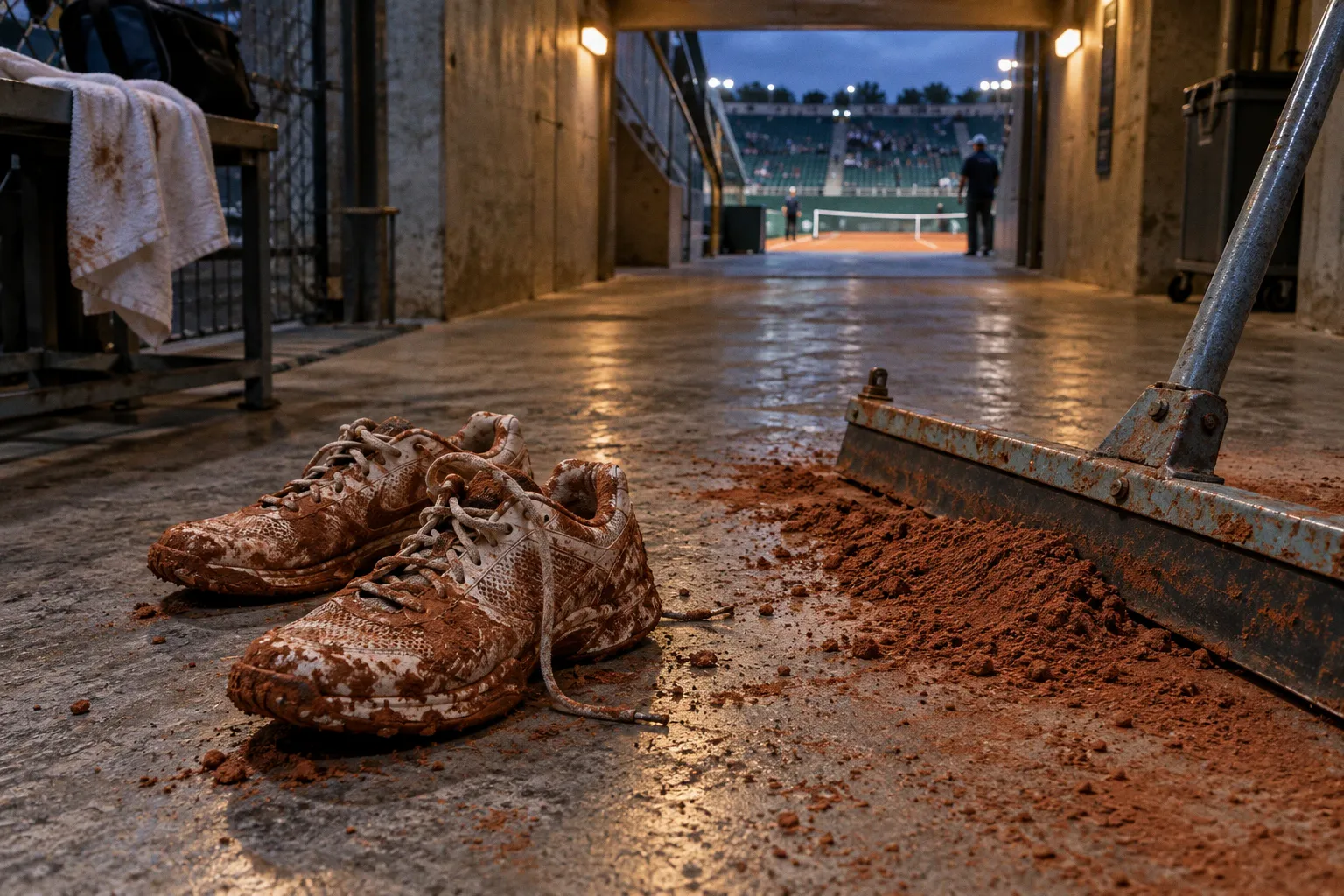
On clay, a player does not simply run toward the ball and then stop. The final steps are a negotiation with friction — a controlled surrender of traction that turns forward speed into balance, spacing, and recovery.
The numbers help explain why the movement feels so different. Measurements of court behaviour place the ball’s coefficient of sliding friction on clay at roughly 0.8, compared with approximately 0.6 on fast grass. That figure describes the ball rather than the player’s shoe, so it should not be treated as a direct measure of how far a player will slide. Still, it captures something essential: clay has a different relationship with motion. The ball grips the court more than it does on fast grass, while the player, under the right conditions, can release the shoe into a long, low, controlled glide.
This is the central principle of clay court slide technique on different surfaces: the movement is not an ornamental flourish added to footwork. It is a way of managing impact and momentum when the court allows the player to keep moving through contact.
The tribology of the baseline: friction and surface dynamics
Clay rewards players who understand that traction is never an abstract quality. It is a conversation between the shoe, the particles, the court’s moisture, the player’s body weight, and the direction of travel.
On a hard court, the shoe usually meets a relatively stable painted surface. The player can plant, brake, and push away with a fairly immediate transfer of force. The foot lands, the sole resists movement, and the body changes direction around that planted base. That resistance can be useful, but it also means the joints absorb the consequences of an abrupt stop if the player arrives too tall or too late.
Clay is more permissive — and more demanding. The shoe can travel across the top layer rather than locking into it. Instead of asking the foot to bring the body to a sudden halt, the surface lets the player spread deceleration across a longer interval. The slide becomes a braking phase. The hips lower, the centre of gravity settles, and the player arrives at the ball with movement still flowing through the shot.
That flow is why sliding on tennis courts should not be confused with losing balance. A poor slide is passive: the foot escapes, the torso falls behind, and the player reaches for the ball from an unstable base. A good slide is active: the player enters with intention, keeps the trunk organised, meets the ball at the end of the movement, and is already preparing to recover.
The difference is felt most clearly at the baseline. When a wide ball pulls the player toward the doubles alley, the body must cover distance without spending all its energy on a hard stop. On clay, the outside leg can extend into a controlled glide, allowing the player to hit while the body is still completing its lateral travel. The final position is not frozen. It is a temporary platform from which the next movement begins.
On clay, the slide is not the end of the run; it is the part of the run that makes the next shot possible.
The court’s friction also shapes the ball’s behaviour. Clay generally takes pace from the ball more readily than a fast grass surface, and its bounce gives the receiver more time to read the shot. But the extra time is not free. Rallies stretch, the opponent can ask repeated questions of the same corner, and every recovery step becomes part of the tactical exchange. The player who slides efficiently preserves energy and court position; the player who brakes badly spends both.
Ball friction is not shoe friction
This distinction deserves care. A coefficient of sliding friction measured for the ball cannot be transferred directly to the outsole of a tennis shoe. Shoe movement depends on rubber compound, tread pattern, body weight, approach speed, the angle of the foot, and the texture and moisture of the clay. There is no single universal sliding distance for red dirt.
The surface itself is not uniform, either. Particle size affects the mechanical interaction between shoe and court. Research conducted around the Conde de Godó tournament in Barcelona found that variations in clay particle size altered shoe kinematics and the friction experienced during controlled slides. In practical terms, two courts may share the same red colour and still ask for subtly different footwork.
That is why experienced clay players make small adjustments during the opening games. They are not merely judging whether the court is “fast” or “slow.” They are reading how much the shoe releases, how quickly the outside foot travels, how much the ball sits after the bounce, and whether the surface gives a clean response under a hard plant.
Why clay demands less knee flexion
The body changes its shape to cooperate with the slide. Biomechanical studies comparing a running forehand on low-friction clay with movement on a higher-friction hard court found that players maintained less knee flexion on clay — about 5.6 degrees less at impact and roughly 13.1 degrees less at peak flexion, with considerable variation between movements.
That finding does not mean clay players stand upright. The effective clay stance remains low, broad, and prepared. The distinction is more precise: the player does not need to fold as deeply into the knees in order to absorb a sudden stop, because the slide is distributing the braking action through the surface and the moving leg.
On a hard court, the foot may plant and the knee may bend sharply as the body decelerates. On clay, the foot can continue travelling, so the knee does not have to absorb the entire change of speed in one instant. The player lowers the hips, keeps the torso controlled, and lets the leg extend along the direction of the slide. This is a different solution to the same problem of reaching a wide ball.
The most reliable technical foundations are straightforward:
1. Enter with a low centre of gravity. The hips should drop before the slide begins, rather than collapsing after the foot has already lost traction. A low position keeps the body connected to the movement and gives the player room to adjust the racket and upper body.
2. Use a wide, stable base. A shoulder-width stance provides room for the legs to manage lateral force. Narrow steps tend to produce a hurried, upright slide in which the player cannot control the exit.
3. Let momentum carry the movement. The slide should travel toward the contact point. If the player releases the foot too early, the body stops short and the ball is contacted from a cramped position. If the slide continues too far, recovery becomes late.
4. Keep the upper body quiet enough to strike. The legs may be moving quickly beneath the player, but the head and shoulders should not be thrown sideways. A stable head helps preserve timing, especially when the ball is arriving high or with heavy topspin.
5. Finish the slide at contact. The end of the glide should coincide with the hitting position, not with a separate pause before the swing. On a wide forehand, the racket can accelerate while the lower body is still completing its controlled travel.
The phrase “less knee flexion” can be misunderstood. It does not invite stiff legs. Stiffness makes the slide harsh, and it prevents the player from absorbing changes in the court. The useful position is soft but not deeply compressed — knees bent, hips lowered, and the body ready to release force through the moving foot.
Hard court versus clay court movement
| Movement demand | Hard court | Clay court |
|---|---|---|
| Braking | Often relies on a planted foot and sharper deceleration | Can distribute deceleration through a controlled slide |
| Knee action | Greater flexion may be used to absorb a rapid stop | Studies show less knee flexion during comparable running forehands |
| Foot-surface relationship | More immediate grip and push-off | Variable release, affected by particles and moisture |
| Recovery rhythm | Stop, load, then push away | Glide through contact, then redirect |
| Main technical risk | Overloading the planted leg or arriving too upright | Losing balance through an uncontrolled or mistimed slide |
The table is a guide rather than a rigid division. Players can slide on some hard courts, and they must still brake and plant on clay when the ball arrives short or changes direction sharply. Surface does not remove technique; it changes the margin in which technique operates.
The geometry of the slide: momentum, contact, recovery
A clay slide has a beginning, a middle, and an exit, although the best players make those stages appear almost continuous.
The beginning is the approach. The player recognises the direction of the ball, turns the hips and shoulders, and takes the first steps with enough speed to reach the shot. The slide cannot repair a slow or poorly angled approach. It is the final expression of the run, not a substitute for reading the ball.
The middle is the release. The outside foot, or the foot nearest the direction of travel, begins to move across the surface. The player lowers the body and allows the shoe to travel rather than forcing an abrupt stop. The leg remains engaged; it is not simply dragged behind the torso. This is where the player manages friction, applying enough pressure to control the line of movement without gripping so hard that the glide disappears.
The exit is the contact and recovery. The player should reach the ball at the end of the slide, with the racket prepared and the body already oriented toward the next phase. When the shot is struck, the leg that has managed the slide helps redirect the body back toward the court. The recovery may begin before the opponent has hit the ball again, because the sliding phase has not left the player stranded outside the court.
This is why a clay court slide can look slower than a hard-court plant but still be more efficient over a long rally. The player is not spending a separate movement to stop and another to restart. Braking, hitting, and the first part of recovery are joined together.
The common errors are mechanical, not mysterious
When a player says that sliding feels impossible, the issue is often not courage but timing. Several habits make the movement unstable:
- Entering too upright. The foot then reaches the surface before the hips are ready to lower, and the slide becomes a fall rather than a controlled release.
- Trying to stop before the slide. This removes the momentum the movement requires. The player brakes early, reaches the ball late, and has no useful glide left.
- Reaching with the foot instead of the body. A long, isolated step places the shoe far ahead of the hips and makes the knee absorb a sudden load.
- Watching the slide instead of the ball. The player becomes preoccupied with the feet and loses the visual information needed for contact timing.
- Allowing the torso to lean away from the court. This sends the centre of mass outside the line of recovery and turns a wide defensive shot into a stranded position.
- Treating every ball as a sliding ball. A short ball, a sudden change of direction, or a damp patch may require a compact plant rather than a long release.
A player learning how to slide on tennis courts should therefore begin with controlled lateral movement and clear contact points, not with dramatic full-speed attempts. The objective is to feel the connection between approach speed, hip height, foot release, and recovery direction.
Environmental variables: moisture changes the bargain
Clay is especially sensitive to weather because water changes the relationship between particles. A dry court may feel loose beneath the shoe, allowing a longer and more generous release. Moisture can make the surface stickier, increasing traction and reducing the speed of the ball and the height of its bounce. Rain alters the court further, sometimes creating patches with noticeably different resistance within the same baseline area.
This is where a player’s first impression can become misleading. A court that appears slow because the ball is not travelling quickly may still offer more resistance under the shoe. A damp surface can demand greater pressure through the foot and a more deliberate lowering of the hips. The player who uses the same release as on a dry afternoon may not slide as expected; the foot grips, the body checks abruptly, and the timing of the stroke shifts.
Weather also changes the tactical value of the slide. On a dry, loose court, a defender may use a long outside slide to reach a ball and create enough space for a high, heavy reply. On a moist court, the same movement may finish sooner, leaving less room to swing and less time to recover. The adjustment is not simply to move faster or slower. It is to change the point at which the foot begins to release and the amount of force used to initiate the glide.
A practical reading of the court should include:
- The first few lateral pushes: Do they release smoothly, or does the shoe catch?
- The sound beneath the foot: A soft, loose scrape suggests a different surface response from a dense, sticky drag.
- The ball after the bounce: Reduced pace and lower bounce can indicate a heavier, more moisture-affected court.
- The court’s worn zones: Areas near the baseline and service lines may behave differently from untouched sections.
- The recovery after a wide ball: If the slide carries the player too far or ends abruptly, the next movement needs to change immediately.
None of these signs replaces feel. They refine it. Clay rewards attention because the surface is always giving information through the shoe.
The best clay movement is not a fixed technique repeated against every court; it is a stable set of principles adjusted to the friction underfoot.
Adapting to texture: particle size and shoe kinematics
The red dirt is often spoken about as though it were a single material, but the court’s texture has a mechanical identity of its own. Particle size affects how the shoe engages with the top layer, how the surface displaces under pressure, and how much the foot can travel before the court offers resistance.
A finer, more compact layer may give the shoe a cleaner and more predictable response. A looser or more varied layer can produce a less uniform slide, especially when the player arrives at an angle or tries to change direction during the glide. The difference may be small enough to escape notice during a casual rally and large enough to affect a professional’s final step into a wide forehand.
This is one reason the clay-court season contains such variety even when the broad tactical language remains familiar. The same player can look wonderfully free on one red court and slightly delayed on another, not because the fundamentals have disappeared but because the frictional conversation has changed.
The shoe matters as well. Tread and rubber determine how readily the sole releases, but the player should not search for a magic outsole that removes the need for adaptation. Footwear can influence the margin; it cannot decide the slide’s timing. The player still has to arrive with the correct momentum, keep the hips low, and allow the foot to move along the court rather than against it.
Clay court movement drills
A useful progression should preserve the order of the movement: approach first, release second, contact third, recovery last. Drills become less helpful when they isolate a theatrical slide from the footwork that makes it functional.
1. Shadow approach and release
Begin without a ball. Move laterally from the centre of the baseline, lower the hips during the final steps, and allow the outside foot to travel into a short slide. Hold the position only long enough to feel whether the torso remains balanced, then recover through the court rather than standing up in place.
The measure of success is not distance. It is whether the body arrives under control and can leave the position without a second adjustment step.
2. Fed-ball wide forehand
A coach or partner feeds a moderate ball toward the forehand corner. The player should focus on reaching the contact point at the end of the slide, using enough height and pace to make the ball playable rather than turning the exercise into a maximal defensive sprint.
The feed can gradually move wider, but the technical priority remains the same: the slide should carry the player to the ball, not beyond it.
3. Alternating corners
From the centre, move to one side, recover, and then respond to a ball on the opposite side. This teaches the player that the end of the slide is also the beginning of the next movement. If the player finishes each repetition facing the wrong direction, the issue is usually in the recovery geometry rather than the length of the slide.
4. Variable surface awareness
Repeat the movement at different times or on courts with noticeably different moisture and texture. The player should identify the release of the shoe before increasing speed. A court that offers more traction may require a later, shorter release; a looser surface may allow the slide to begin earlier.
The purpose is not to memorise a response to “fast clay” or “slow clay.” It is to build the habit of listening through the feet.
What the slide reveals about clay-court tennis
The mechanics of sliding explain much of the larger character of clay-court tennis. Longer exchanges are not produced by surface speed alone. They emerge from the way the court lets players defend wide areas, absorb momentum, and recover from positions that would be more punishing on a grippy hard court. The surface gives the body a different route through danger.
That route demands patience. The player must read the ball early enough to arrive with useful momentum, then resist the temptation to fight the court with a rigid plant. The best movement is often quieter than spectators expect: a lowered centre of gravity, a foot released at the right instant, a torso kept steady while the lower body travels, and a recovery that begins before the point has visibly turned.
For players moving between surfaces, the adjustment is not a matter of importing one style and abandoning another. Hard court footwork teaches the value of a strong plant, precise loading, and immediate push-off. Clay adds a longer braking phase and asks the player to remain mobile through contact. The two surfaces share the same athletic problem — reach the ball in balance and be ready for the next one — but they solve it through different arrangements of friction and momentum.
A reliable clay court slide technique on different surfaces therefore rests on three questions:
1. How much resistance is the court giving the shoe today?
2. Where should the slide end in relation to the ball?
3. Can the body leave the position in time for the next shot?
If the answers remain connected, sliding becomes a form of economy rather than spectacle. The player covers more court without turning every wide ball into a collision with the surface. The knees, hips, and feet work together instead of taking turns absorbing the consequences of late movement.
Clay will never offer a single, permanent answer. Dryness, rain, particle size, shoe design, approach speed, and body position all alter the bargain underfoot. That instability is part of the court’s identity — and part of its history as a surface that rewards craft over force alone.
To slide well is to accept the court’s resistance without surrendering to it. The player gives up just enough traction to keep moving, keeps enough structure to strike the ball, and leaves the slide already prepared for what comes next.