Somewhere along the way, the visual hierarchy of professional tennis quietly inverted itself.
Welcome to the U.S. Open, where the coaching box has been rebranded as a rotating billboard, and the most-watched piece of real estate on the broadcast — the box itself — belongs to someone who isn't even swinging a racket.
The Coach as Living Logo
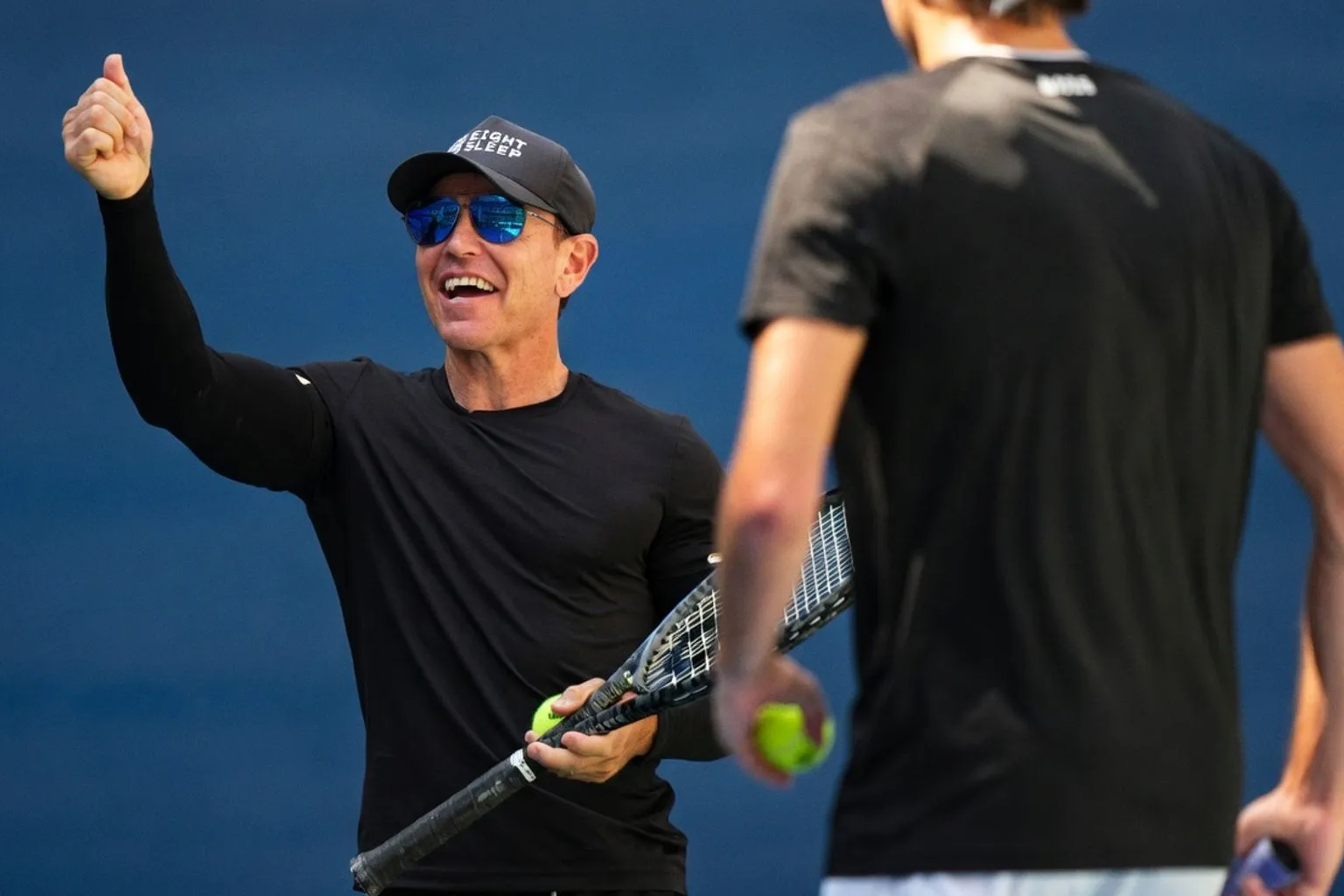
Michael Russell, the man guiding Taylor Fritz's tactical decisions from the sideline, has become the circuit's most decorated walking advertisement. Patches from Waterdrop and Solinco. A hat from Eight Sleep. Another from Papatui, the men's skincare outfit launched by Dwayne Johnson. Some days he throws a Carvana shirt into the rotation. Russell isn't an outlier. He's a template.
The pattern is everywhere once you start looking. Anton Dubrov, sitting behind Aryna Sabalenka — world No. 1, two-time defending champion, primetime fixture — wears Eight Sleep. Frédéric Fontang, working with Jiří Lehečka, wears Eight Sleep. Jamie Delgado, in Grigor Dimitrov's corner, wears Eight Sleep. Carvana sits on the kits of Amanda Anisimova's, Madison Keys's, and a dozen other support staffs. The camera cuts to the coaching box between every changeover, and the box cuts back with a small fleet of brand identifications.
The product behind the most ubiquitous patch, Eight Sleep, makes high-tech mattress covers that heat or cool on command and track sleep cycles. It's a quietly intimate pitch: while the player chases a forehand down the line, the coach is selling you the bed you'll sleep in afterward.
Why the Coach Box, Specifically
The logic is colder than the branding suggests. As Alexandra Zatarain, a co-founder of Eight Sleep, put it to The New York Times, the company figured out that the people who actually run a player's daily life — the nutritionist, the physio, the fitness trainer, and yes, the coach — are the ones who decide whether anyone sleeps on the product at all. So the company stopped courting the athlete and started courting the staff.
"We had this idea of just, 'Oh, what if we make the coaches our partners because they are actually a really important partner in making sure that the player stays on track in terms of all of their health,'" Zatarain said.
Read that back. The athlete is the billboard's neighbor; the coach is the billboard itself. The marketing calculus has moved from "sell to the person with the trophy" to "sell to the person who decides what time the trophy-winner turns the lights off." It is the most quietly cynical sponsorship pivot in the sport.
The Truce That Quietly Bought the Silence
The backdrop is worth naming. By the time the draws narrowed in New York, the players' year-long public campaign against the Grand Slams — demanding prize money closer to 22 percent of each tournament's revenue — had formally ended. The U.S. Open purse for this edition sat at roughly £79.2 million (around $108 million), with an additional £1.47 million pledged to a player welfare fund. A Grand Slam Player Advisory Council was announced to give the tours a direct line into the majors.
Sabalenka herself framed the fight, back in Paris, as not being about her own jewellery or her own cut, but about the players ranked deep enough that a single Slam appearance is what keeps the season alive. Whether that framing holds once the council starts meeting is a different essay. What is clear in Flushing Meadows is that the players have the microphone and the coaches have the merch. The sport, for now, is selling both.