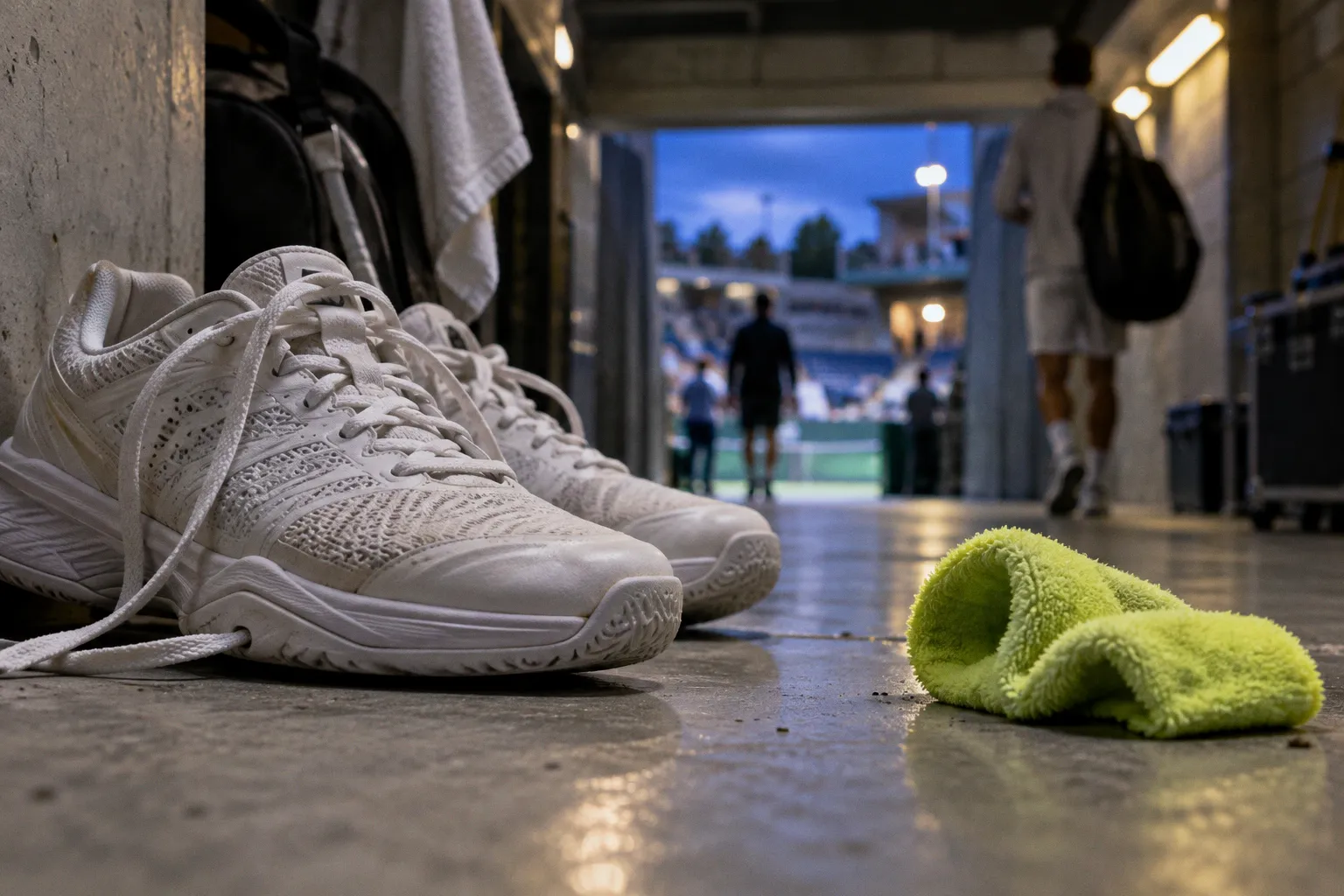
In the late nineteenth century, white fabric concealed perspiration more effectively than darker colors, allowing players to remain within the standards of polite society while moving through the physical strain of a match. By the time the first Wimbledon Championships were held in 1877, white had already become more than a useful shade: it was becoming the visual language of the court.
Today, that language sits beside an entirely different material reality. Polyester draws moisture away from the skin, elastane gives with the shoulder and hip, and modern garments are engineered to endure repeated washing, explosive changes of direction, and long hours under heat. The tennis white clothing tradition versus modern performance gear is therefore not simply a conflict between old taste and new technology. It is a question of what the court is permitted to remember — and what the player’s body is now allowed to demand.
The Victorian origins of the all-white aesthetic
The early preference for white was tied to social rules as much as to tennis itself. Sweat stains were considered improper in polite Victorian society, particularly in the leisure spaces where lawn tennis developed. White helped reduce the visible evidence of exertion, at least in comparison with many colored fabrics, and allowed the sport to present physical labor as controlled recreation.
That distinction matters. Tennis was never a motionless pastime, even when its public image was carefully composed. The player still had to lunge, recover, twist through the serve, and absorb the shock of repeated impact. Yet the social ideal surrounding the game preferred to see discipline rather than strain. White clothing served that ideal because it made the body appear cleaner, quieter, and more contained.
The first Wimbledon tournament, held in 1877, established the setting in which this aesthetic would acquire unusual authority. The grass court already carried a strong visual identity: pale lines, clipped green, white net tape, and the restrained architecture of an English club. Clothing that echoed the court’s brightness did not merely satisfy a dress preference. It helped create a unified scene in which players, surroundings, and spectators belonged to the same social composition.
Over time, tennis whites became associated with qualities that had little to do with the fabric’s original function:
- restraint rather than flamboyance;
- club tradition rather than commercial display;
- cleanliness and composure rather than visible exertion;
- continuity with Wimbledon’s Victorian inheritance;
- an idea of tennis as ritual, not only competition.
This is why the white rule has survived changes in racket construction, court preparation, training methods, athlete nutrition, and match tempo. It became part of tennis lore because it offered a stable surface over which the sport could keep changing.
White was chosen to hide the evidence of effort; over time, it came to represent the effort’s proper place within tennis culture.
But the tradition has always contained a tension. White may soften the visible signs of sweat, yet it does not make the work of the match any less severe. A modern professional can cover the court with greater speed, strike with more rotational force, and play under a far more exacting physical schedule than the Victorian player for whom the dress code first became meaningful. The clothing remained symbolically calm while the body beneath it became increasingly athletic.
Fabric changed before the rules did
The evolution of tennis apparel technology has been driven by a simple fact: the modern player produces more heat, more movement, and more repetitive stress than the old visual language of lawn tennis was designed to accommodate.
Traditional natural fibers such as cotton offered familiarity and breathability, but they also absorbed moisture and could become heavy during a long match. Wool had its place in earlier sporting dress, particularly in cooler conditions, yet it was not suited to the full range of movement required by elite tennis. The modern game needed materials that could stretch, recover, dry quickly, and remain stable against the skin.
Synthetic fibers answered that demand. Polyester became central to performance clothing because it can move moisture away from the body and maintain its shape under repeated use. Elastane — also known as spandex or Lycra — added a different quality: controlled extension. Invented in 1958 by Dr. Joseph Shivers, the fiber can stretch to several times its original length, with the commonly cited capacity reaching approximately 500 percent. That kind of elasticity changed the relationship between garment and movement.
A cotton shirt follows the player’s action imperfectly. A well-designed synthetic shirt is built around it. The difference appears in small moments rather than theatrical ones — the shoulder rotating through a serve, the torso folding into a low backhand, the fabric returning to position after a slide or a sudden recovery step. At professional level, these details accumulate. A seam that rubs, a waistband that shifts, or material that holds sweat against the skin can become part of the match.
| Material consideration | Traditional natural-fiber clothing | Modern synthetic performance gear |
|---|---|---|
| Moisture management | Absorbs perspiration and may become heavier as play continues | Designed to move moisture away from the skin and dry more quickly |
| Range of motion | Can restrict movement when wet or tightly woven | Elastane blends provide greater stretch and recovery |
| Durability | Comfortable and familiar, but may lose shape or wear with repeated washing | Built to retain structure through intensive use and laundering |
| Sensory experience | Soft, breathable, and often more tactile against the skin | Lighter, closer-fitting, and engineered around heat and movement |
| Visual identity | Supports the historical image of tennis whites | Carries the language of modern sport, branding, and technical design |
| Relationship to the body | Garment sits around the player | Garment follows the player’s mechanics more closely |
This is where the debate over aesthetic versus utility in tennis fashion becomes more complicated. Synthetic clothing is not automatically less elegant, and traditional clothing is not automatically impractical. The strongest modern designs often preserve visual restraint while concealing a highly technical interior: bonded seams, mesh panels, stretch zones, and fabrics selected for temperature, friction, and recovery.
The court sees white. The body experiences engineering.
Wimbledon and the precision of tradition
Wimbledon’s dress code is often described casually as an all-white rule, but its strictness lies in the details. The All England Lawn Tennis Club’s ten-point dress code specifies that white does not include off-white or cream. Colored trim around the neckline and sleeve cuffs is permitted only as a single band no wider than one centimeter. These measurements reveal the character of the rule more clearly than the general phrase “all white.” This is not simply a preference for pale clothing. It is a system of visual control.
The white requirement applies to the appearance of the player, but it also protects a particular atmosphere. Wimbledon’s grass courts, old buildings, flower borders, and restrained public presentation depend on continuity. The tournament has never been only a competition staged on grass. It is also a carefully maintained idea of what a major tennis occasion should look like.
That idea can seem inflexible when placed beside the global tennis calendar. Players travel between tournaments where vivid colors, large graphics, visible branding, and experimental silhouettes are normal. Their clothing may be adapted for heat, humidity, wind, indoor lighting, or the demands of a particular sponsor campaign. Wimbledon asks them to pass through a narrower visual gate.
Yet the rule does not ban synthetic fibers. This distinction is often blurred in discussions of the Wimbledon all-white rule debate. A player can wear modern polyester and elastane blends, moisture-managing panels, and technically constructed shoes while still meeting the color requirements. The conflict is not between Victorian cotton and contemporary fabric in any literal sense. It is between a historical appearance and the freedom to display modern design.
That distinction gives Wimbledon’s tradition its unusual durability. The tournament can accept the machinery of modern sport while limiting its visible expression. Rackets may become lighter and more powerful; strings may alter the ball’s response; shoes may be designed around complex patterns of traction. The player’s shirt, however, must continue to belong to the same visual family as the shirt worn generations earlier.
There is dignity in that continuity, but also a cost. Clothing communicates identity, and the more closely a rule controls color, the more directly it controls the ways players can present themselves. Tennis has long marketed individual personalities — their gestures, rivalries, biographies, and styles — while asking them to enter certain courts dressed according to an inherited code.
Agassi, Federer, and the cost of refusing the uniform
Andre Agassi’s relationship with Wimbledon remains one of the clearest examples of clothing becoming part of a player’s public identity. He boycotted the tournament from 1988 to 1990 because he refused to adhere to its strict all-white dress code. The gesture was not simply a complaint about fabric. Agassi understood that clothing could challenge the authority of the setting, and that a tournament’s image could exert power over the athlete who entered it.
His return carried a measure of reconciliation. In 1992, Agassi won Wimbledon wearing white. The image is more complicated than either rebellion or surrender. He did not become less distinctive because the clothing changed color; nor did the tournament entirely lose its authority because a previously resistant player lifted the trophy. Instead, the episode showed how tennis absorbs conflict and turns it into history. The dress code survived, but so did the memory of the player who had resisted it.
The same tension appeared in a smaller but revealing incident involving Roger Federer. In 2013, the eight-time Wimbledon champion was reprimanded by tournament officials for wearing shoes with orange soles and was required to change them for his subsequent match. The orange was not a performance threat. It did not alter his footwork or the grass beneath him in any meaningful sporting sense. Its significance was visual — a bright interruption in a space that had been designed to suppress interruption.
That is precisely why the incident mattered. A small amount of color could become a question about who controls the image of the tournament: the player, the sponsor, the equipment company, or the institution. On most professional courts, that question would pass without consequence. At Wimbledon, a colored sole could become an act of nonconformity.
Nick Kyrgios encountered a similar boundary in 2022, when he reported being fined approximately £8,000 after wearing a bright red cap and red trainers during on-court post-match activities. The episode illustrates how carefully Wimbledon distinguishes between athletic function and ceremonial appearance. The match may be over, but the court remains part of the tournament’s visual territory. What a player wears after competition can still be treated as part of the public presentation.
These cases are not identical, and they should not be reduced to a simple list of rebellious athletes. Agassi challenged the code over several years; Federer’s shoes represented a narrow breach; Kyrgios’s reported fine concerned accessories and post-match conduct. Together, however, they reveal how tennis clothing operates at different levels:
1. As equipment, it must allow the player to move, sweat, recover, and compete.
2. As branding, it carries sponsors, manufacturers, and personal identity.
3. As costume, it places the player within the history of the tournament.
4. As discipline, it marks the limits imposed by the institution.
5. As memory, it allows particular acts of refusal to survive long after the match itself.
The sharper the rule, the more visible a breach becomes. A red cap would disappear into the ordinary visual noise of another tournament. At Wimbledon, it becomes a small event because the surrounding field has been deliberately reduced to white.
The body has entered the dress-code conversation
For much of tennis history, the discussion around dress codes centered on decorum, tradition, and the visual character of the venue. Modern professional sport has made it harder to treat clothing as a matter of appearance alone. The garment sits directly against the athlete’s work, and some forms of discomfort cannot be dismissed as aesthetic inconvenience.
In 2023, Wimbledon updated rule nine of its ten-point dress code to allow female players to wear solid, mid- or dark-colored undershorts. The change was introduced to relieve anxiety surrounding menstruation. It did not permit any colored outer skirt, and the undershorts must not extend beyond the white skirt, but the adjustment was nevertheless significant. It acknowledged that the historical whiteness of the uniform could create a specific and serious burden for players.
The change is modest in physical terms. A layer beneath the skirt does not transform the silhouette of the athlete or the appearance of the court. Its meaning is larger because it shifts the center of the discussion from what spectators expect to what players need in order to compete without avoidable anxiety.
This is where functional sportswear in professional tennis presses against inherited custom most persuasively. The strongest argument for technical clothing is not that modern design is fashionable. It is that tennis is a sport of repeated acceleration, sudden braking, heat accumulation, and sustained concentration. Clothing must work within that environment, and the player must be able to trust it.
That trust includes more than stretch and moisture management. It includes confidence that the garment will remain secure during movement, that it will not create unnecessary friction, and that the player will not spend a portion of the match monitoring the clothing instead of the ball. The physical realities of the sport do not become less real because the tournament has a beautiful tradition.
A dress code earns its place in tennis history when it protects the character of the court without asking the player to ignore the realities of the body.
The 2023 change suggests that tradition can be revised without being discarded. Wimbledon did not abandon white. It made room within white for a practical concession that had become impossible to defend as mere fussiness. That is often how sporting customs change: not through a dramatic rejection, but through the gradual recognition that the old boundary has begun to interfere with the sport it was meant to frame.
Aesthetic discipline and athletic freedom
The contrast between tennis whites and synthetic tech is sometimes presented as though one side must defeat the other. In practice, elite tennis has already created a compromise. The clothing is technically advanced and visually restrained; the fabric belongs to the future while the color continues to refer to the past.
This compromise can be seen across the professional game. Players wear garments made from synthetic fibers that offer stretch, moisture management, and durability, yet those garments may be cut to preserve a familiar silhouette. A polo can carry sophisticated material construction while looking, from the stands, like a descendant of an older shirt. The visual surface remains calm even when the engineering beneath it has changed completely.
The result is not a clean victory for utility. Performance apparel also carries the pressures of the modern sports economy. Bright colors, distinctive patterns, and recognizable silhouettes help manufacturers sell the idea of speed and individuality. A player’s kit can become part of a seasonal campaign, a collectible object, or a fragment of cultural memory. The body is still being served by the garment, but the garment is also speaking to an audience beyond the court.
Tennis fashion has always carried this double function. Victorian white concealed sweat while maintaining social decorum. Contemporary synthetic clothing manages sweat while presenting a marketable image of athletic precision. In both periods, the fabric performs a physical task and a cultural one.
The difference is that modern technology makes the garment more intimate. A natural-fiber shirt may have been worn as part of a general sporting uniform. A contemporary shirt is more likely to be mapped onto the movements of a particular athlete: the shoulder line of a server, the torso rotation of a two-handed backhand player, the recovery patterns of someone who covers the court with unusual width. Design now follows biomechanics more closely, even when the spectator sees only a clean block of color.
This makes the Wimbledon rule less an argument against technology than an argument about visibility. The tournament accepts the technical transformation of clothing so long as that transformation remains visually subordinate to the court’s inherited identity. The material can change. The public image must change more slowly.
What tennis clothing remembers
The history of tennis dress codes is ultimately a history of what the sport chooses to make visible. Victorian whites made exertion socially acceptable by softening its appearance. Modern synthetic fabrics make exertion physically manageable by responding to heat, moisture, and movement. Wimbledon’s regulations place a limit on how much of that modernity may appear on the surface.
None of this makes tradition meaningless. A court is never only a measured rectangle with a net across its center. It is also a set of expectations carried through surfaces, colors, sounds, and habits. Wimbledon’s white clothing belongs to that material history in the same way that grass, old timber, and the texture of a worn leather grip belong to it. Remove every inherited element in the name of efficiency and the tournament would lose part of the atmosphere that gives its matches meaning.
But tradition becomes fragile when it treats the athlete as a decorative figure rather than a working body. The allowance for dark undershorts in 2023 was valuable precisely because it did not confuse reverence with immobility. It preserved the visual character of the event while accepting that the player’s comfort and concentration had to carry greater weight.
The most convincing future for tennis apparel is not a victory of synthetic technology over white clothing, nor a return to cotton in pursuit of historical purity. It is a more intelligent coexistence:
- technical materials should continue to respond to heat, friction, stretch, and recovery;
- dress codes should distinguish between disruptive display and genuine athletic need;
- historical venues should be allowed to preserve their visual character without freezing the player’s body in the past;
- designers should understand that restraint can be as expressive as color;
- institutions should revise inherited rules when those rules create burdens unrelated to the quality of competition.
The battle for court identity, then, is not really between tradition and progress. It is between two definitions of what a tennis court is for. One sees the court as a historical stage whose appearance must be protected. The other sees it as a demanding physical workplace where clothing should disappear into performance.
The wisest version of the sport allows both truths to remain. White can still carry the memory of Victorian lawn tennis. Polyester and elastane can still make the modern game possible. Between them lies the real texture of tennis — friction against grass, tension through the shoulder, heat held in the air, and the quiet discipline of a player trying to make the body serve the point.