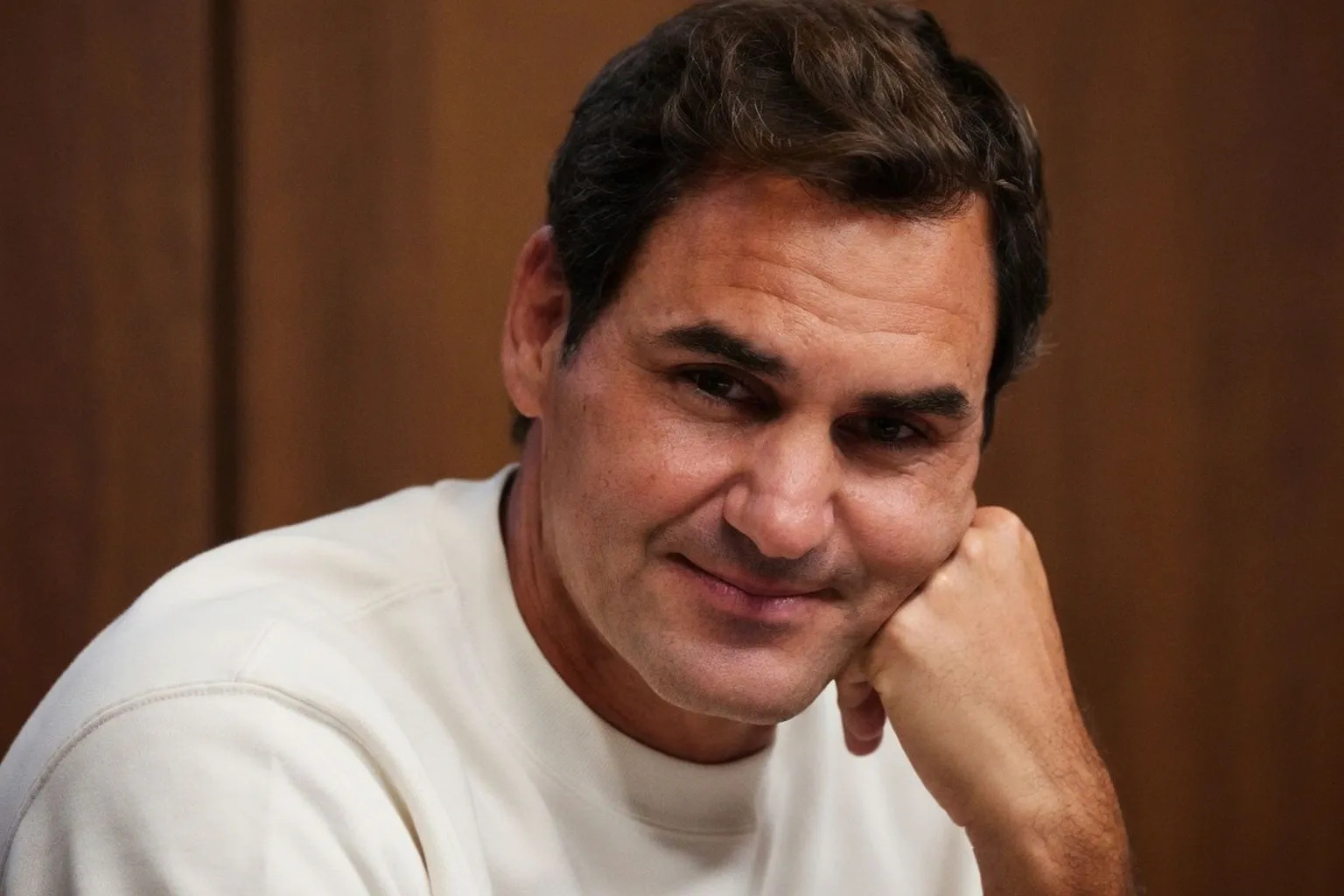
The Chalk Lines Under the Cathedral
It was a 45-year-old Roger Federer, voice fracturing, recounting how he once drew the lines of a tennis court in chalk as a boy so he and his friends could play. Tennis, he said, became the fabric of his life. Five years after his final singles match, the International Tennis Hall of Fame finally had him on stage — introduced by his wife Mirka, flanked by their four children, pausing repeatedly to compose himself across a thirty-minute speech. A man who spent two decades performing control in front of millions suddenly could not contain the smallest tremor. That contrast is the story.
The Records Are Not the Legacy
The Guinness-certified numbers are staggering and worth reciting only because they reveal the architecture of obsession. Twenty Grand Slam titles. One hundred and three tour-level trophies. Twenty-eight Masters 1000s. Six ATP Finals. One thousand two hundred and fifty-one match wins. One thousand five hundred and twenty-six singles matches played on the ATP Tour — itself a record. But the figure that exposes the psychology is the 237 consecutive weeks Federer spent at No. 1, from February 2, 2004, to August 17, 2008. Three hundred and ten total weeks at the summit. You do not hold a position that long through talent alone. You hold it through an almost inhuman refusal to let the moment exceed you. Federer reached 23 consecutive major semi-finals and 36 consecutive Grand Slam quarter-finals. At his peak, he appeared in ten straight major finals. The cognitive load of maintaining that standard — of walking onto Centre Court knowing the entire stadium expects perfection and delivering it again — is something the trophy cabinet can never quite convey. His eight Wimbledon titles remain a men's record. His 2009 final against Andy Roddick, won 16-14 in the fifth set after four hours and seventeen minutes, featured 50 aces — another Guinness mark, in a Grand Slam singles final.
The Rivals Who Made the Man
Here is where the mythology gets uncomfortable, and where the Federer story sharpens into something genuinely interesting. He finished with a losing head-to-head against Rafael Nadal, 16-24, and against Novak Djokovic, 23-27. Those are not footnotes. They are the structural truth of his career. The 2008 Wimbledon final against Nadal — frequently called the greatest match ever played — was also the match where Federer finally met someone whose physicality and stubbornness could not be outpaced. The 2011 US Open semi-final saw Djokovic save match point with a forehand return that remains a scar on Federer's highlight reel. The 2009 French Open, won only after Nadal was knocked out by Robin Söderling in the fourth round, was less a conquest than a door unlocked by another's absence. Mirka tried to reframe this in her own remarks on Saturday, gently noting that the trophies and records are only part of his legacy — that what matters is who he is when nobody is watching. It was a touching deflection, and also a reminder that even those closest to Federer understand the rivalry math better than the public sometimes admits.
The Comeback That Refused the Farewell
The strange late-career chapter is the one least appreciated. Federer's last Grand Slam came at the 2018 Australian Open, where the 36-year-old defeated Marin Čilić. His return to No. 1 in 2017 — five BNP Paribas Open titles tracing the arc of his prime, including the 2004 breakthrough as the new world No. 1 and the 2017 comeback that set the return in motion — proved that his decline was never graceful in the way the elegiac tributes suggest. It was fought for, point by point. His five titles in Indian Wells are a sub-plot in themselves: each one marking a different version of the man. Retiring in 2022 after twenty-four professional years, from a first ATP match in Gstaad in 1998, Federer left the sport not because his body failed but because he chose to. That is the rarest kind of exit in modern tennis, and it is the detail that should linger longest.
Federer used his speech to thank his late coaches Peter Carter and Peter Lundgren, then Paul Annacone, Tony Roche, Edberg, Ivan Ljubičić and Severin Lüthi, pausing hardest when speaking of those no longer alive to witness the night. He insisted he never allowed fame or fortune to alter who he was. Whether you believe that is, ultimately, a question about the man rather than the record book — and the record book, for once, is not the most interesting document in the room.