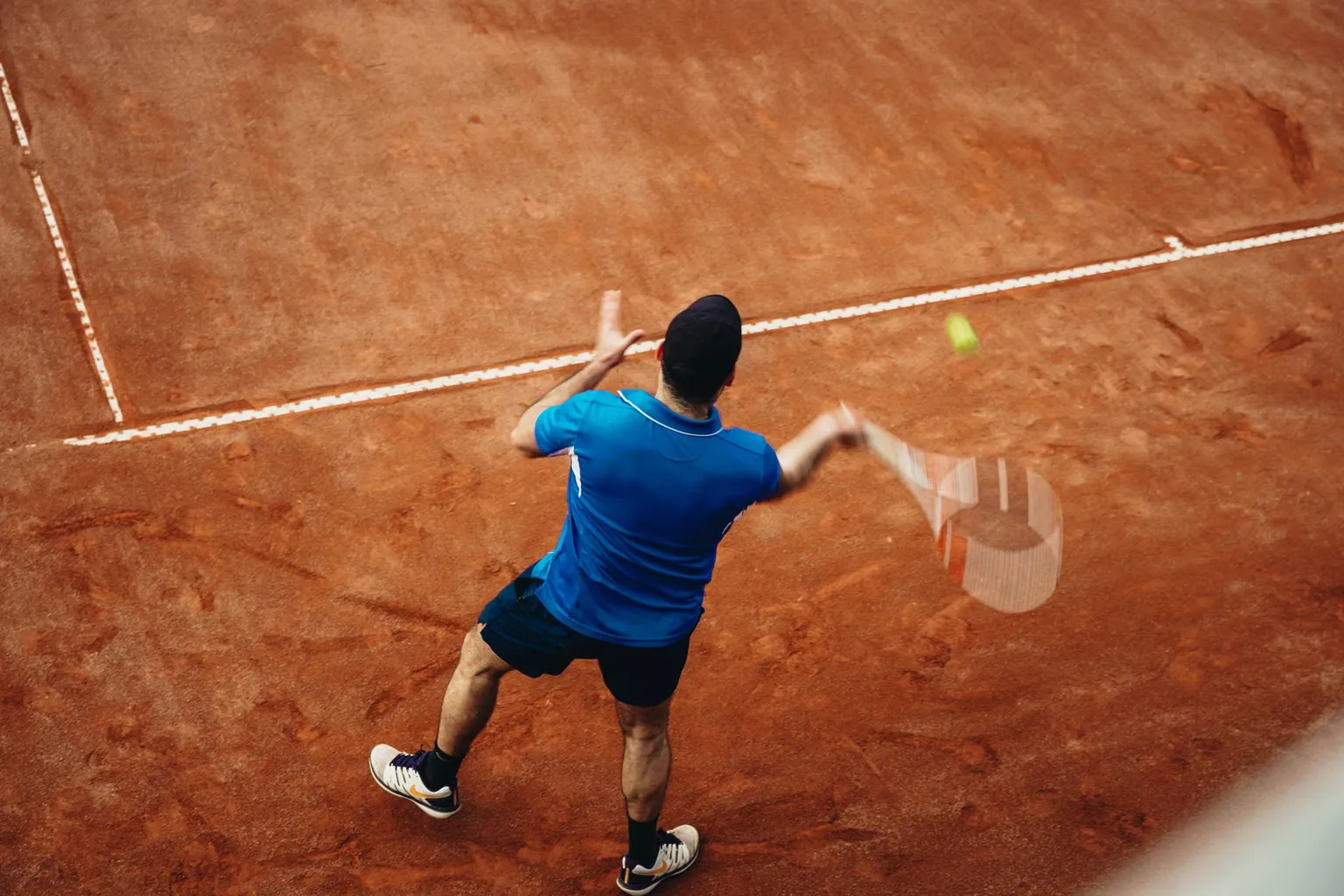
When the racquet lets the ball go at around 115 mph — within the routine working range of an ATP first serve — the returner, standing at the baseline in a standard receiving position, has roughly 0.47 seconds between the server's contact point and their own. At the recorded extreme, Samuel Groth's 163.7 mph blast of 2012 compresses that window to about 0.325 seconds — shorter than a single blink. By the time the average human visual reaction baseline has even finished registering motion, the ball has already covered most of its journey back across the net. What looks on television like a returner "watching and responding" is, in the strict biomechanical sense, something much more interesting than conscious reaction.
This is the cold arithmetic underneath the modern return of serve — and it explains almost everything about the shape of elite tennis.
The 400-Millisecond Threshold: Why Human Vision Fails at 120 MPH
The baseline numbers are unforgiving. Standard visual reaction time to a simple stimulus sits around 200 to 250 milliseconds; to a tactile one, closer to 150 milliseconds. Those figures represent the full arc — from stimulus to the first detectable motor output — not a breakdown of individual neural stages. Add to that the time required to process what has been perceived, decide on a movement, and fire the first muscle contractions of the return swing, and a returner facing a 120 mph first serve is operating inside a budget of roughly 400 milliseconds total, broken roughly into perception, decision, and physical response.
A 115 mph first serve, which is closer to today's tour average at the top of the men's game, gives the returner around 470 milliseconds. A 130 mph serve — the kind that has become almost a calling card at the top of the rankings — eats another slice out of that budget. Groth's outlier serve leaves a window shorter than a single blink, and far too compressed for a returner to gather the ball visually, process its trajectory, and initiate a coordinated swing from scratch. The body simply does not work that fast from a standing start.
This is the physical reality the return of serve is built on top of. It is not, despite what the slow-motion replay may suggest, a contest of who sees the ball earliest. It is a contest of who manages to begin their preparation before the ball has left the server's racquet.
A 120 mph serve grants the returner about 400 milliseconds — and the full visual reaction baseline alone consumes roughly 250 of those before the body has even begun to move.
To put that budget in perspective: a blink of the eye lasts between 100 and 150 milliseconds. A single heartbeat, at resting rate, takes about 800 milliseconds. The returner facing a 130 mph first serve has less time than it takes for half a heartbeat to complete the most complex motor task in the sport. The numbers do not leave room for the kind of deliberate, eyes-on-the-ball tracking that recreational players imagine when they picture a great return. They leave room for something else entirely — something the next section makes explicit.
The Kinematic Shortcut: Decoding the Server's Body Language
Kinematic research on the return of serve, including a 2012 biomechanical study that has since become a touchstone for return analysis, points to a specific conclusion: the anticipatory information needed to launch the forward swing is gathered during the first third of the ball's flight. That is, during the tiny window when the ball is still rising from the server's racquet and travelling toward the net — before it has even crossed to the returner's side. By the time the ball begins its second arc and starts falling toward the strike zone, the returner's racket is, in most cases, already on its way forward.
The data behind this finding quietly transforms what we imagine a returner to be doing. They are not tracking. They are predicting — and the prediction is built from the server's body, not the ball's behaviour. Ball toss height, racket take-back angle, shoulder rotation depth, the spacing of the feet at trophy position, the degree of knee bend at the moment of leg drive: these are the inputs the expert returner is reading. The ball itself, once it leaves the racquet face, is essentially too late as a primary signal.
| Kinematic cue at server's trophy position | Likely returner interpretation |
|---|---|
| Toss high and slightly inside the baseline | Powerful, body-loaded serve — prepare earlier split-step and deeper contact |
| Toss low and to the right (right-hander serving wide) | Slower, kick-style serve — stand farther back and shift laterally |
| Deep shoulder turn, racket dropped behind the back | Flat first serve — expect a sharp, lower contact point |
| Compact take-back, abbreviated trophy phase | Slice serve — anticipate wide, lower trajectory, less pace |
This is why two players with almost identical serve speeds can produce wildly different return patterns against the same opponent. The opponent has read the kinematic signature of one serve but not the other, and the body has launched into a swing appropriate for the wrong delivery. It is also why the best servers in the modern game spend so much effort on disguising their motion — the toss placement, the racquet preparation, the leg drive all engineered to look as similar as possible across flat, slice, and kick variations. The disguise is not cosmetic. It is the primary weapon. A serve that looks the same coming out of the trophy position but lands in three different locations is a serve that defeats the returner's anticipatory machinery at its source.
Consider the practical consequence. A returner who has correctly identified a flat serve down the T from the server's shoulder rotation will have committed to a movement pattern — a slight lean to the forehand side, a shortened backswing, a contact point out in front — before the ball has travelled more than a few feet from the racquet. If the server has disguised a wide slice behind the same shoulder position, the returner is now executing the wrong swing entirely, and the correction window is measured in single-digit milliseconds. At 120 mph, there is no time to abort and restart. The return goes wide, or into the net, or floats short enough to invite a volley winner. The server's deception did not need to be perfect. It only needed to be good enough to consume those final, critical milliseconds of the preparation budget.
The 126 MPH Wall: Where Statistical Return Success Collapses
Out of the laboratory and onto the match court, the serve-speed picture sharpens further. Ball-projection work conducted through Sheffield Hallam University found that successful serve returns decreased rapidly above 126 mph, with aces increasing significantly at speeds over that same threshold. It is not a continuous, gentle decline; it is a step function. Below the threshold, returners can keep pace, more or less, by varying their depth and reading the body. Above it, the geometry of the court starts working against them.
That is what the contemporary men's tour is living inside. The first-serve average at tour level has crept upward through the 2010s and into the early 2020s, and the players who lead the tour in aces per match tend to cluster around or above that 126 mph threshold. The wall is real, and the players at the top of the game have built serve motions whose entire purpose is to push more and more of their deliveries over it.
At roughly 126 mph, the match tilts — return rates fall sharply and aces rise, because the human preparation budget finally runs out.
Returners at the elite level do not pretend otherwise. Their strategy against the hardest servers is no longer to "read and react" but to control the variables they can influence — depth of return position, choice of return direction, the speed of the split-step — and to accept that some serves, particularly on pressure points, are simply going to land unreturned. The data, broadly, supports the surrender. There are not enough milliseconds inside the visual and motor system to make up the gap once serve pace crosses the wall.
The tactical consequences ripple outward from there. When a returner faces a server operating consistently above the 126 mph threshold, the return position itself becomes a strategic variable rather than a fixed habit. Some returners stand a full step or two behind the baseline, trading time for depth — gaining perhaps 15 to 20 additional milliseconds of ball flight at the cost of surrendering court position and allowing the server to dictate with the next shot. Others move inside the baseline, cutting off the ball's flight early and trying to take time away from the server on the reply, gambling that the reduced reaction window is worth the positional advantage. Neither approach solves the underlying problem. Both are attempts to redistribute a budget that the physics of the serve has already overdrawn.
The serve-speed arms race is not, in this light, primarily about power. It is about pushing the delivery past the threshold where the returner's anticipatory system can reliably compensate. A server who can hit 130 mph but whose motion telegraphs the direction has given back much of the advantage. A server who can hit 126 mph from an identical-looking motion on every first serve — flat, slice, kick — has, in the arithmetic of the return, built something close to an unreturnable ball. The speed is necessary. The disguise is what makes it lethal.
Beyond Tracking: The Neuroscience of Subconscious Anticipation
A good return of serve, at the moment of contact, is a small masterpiece of pre-conscious computation. The 250-millisecond visual reaction baseline — the approximate time it takes for a human to detect a stimulus and produce a first motor response — is not the operative number in the way casual analysis assumes. What matters instead is the capacity of the brain to begin constructing a movement plan in the gap between toss and contact, using the server's biomechanics as a coarse template.
What this means in practice is that the returner's preparation is largely complete before the ball has travelled the length of the service box. The nervous system has effectively pre-solved the problem. When the ball finally arrives, the swing the returner executes is closer to a release than a decision — the muscular system executing a movement pattern whose details were sketched in milliseconds earlier, when the server's body still telegraphed enough information to act on.
The 2012 kinematic findings align with what sport neuroscientists describe as a shift from conscious visual tracking to anticipation grounded in stored patterns. Successful returners are not faster, in the strict sense, than less accomplished peers. They have a richer library of serve templates — built from thousands of hours of repetition — and the perceptual machinery to match the live scene to the right template quickly enough that the swing has already begun by the time the ball is over the net. This is the subtler point beneath the cold numbers: the return of serve is a recognition problem dressed up as a reaction problem.
The template library is not abstract. It is built from specific, repeated exposures — the same server's motion, the same toss patterns, the same tendencies on break point versus 30–love. A returner who has faced a particular opponent dozens of times across a career has, in effect, trained a dedicated recognition model for that serve. The model is not conscious. The returner cannot articulate why they leaned left on a serve that went right, or why they held their ground on a delivery that looked, to the untrained eye, identical to the one that preceded it. But the body knew, because the body had seen the pattern before, and the pattern-matching machinery had fired before the conscious mind had anything to report.
This is why return quality tends to improve over the course of a match, and why the best returners in the history of the sport — Djokovic, Agassi, Connors before them — were not simply athletes with fast reflexes. They were athletes with unusually dense template libraries and unusually efficient perceptual systems for matching live input to stored patterns. The reflexes mattered. But the reflexes were downstream of something deeper: a nervous system that had seen enough serves to know what was coming before the ball had left the racquet.
The Myth of the Reactive Return: Why Conscious Sight Is Too Slow
It is one of the more stubborn clichés in tennis commentary that the receiver "sees the ball off the racquet and reacts." Biomechanics and reaction-time data agree that this is, at elite pace, simply not what happens. At 130 mph and above, the ball is travelling too fast for a returner to gather meaningful post-impact visual information before they need to be moving; their swing would either be in vain or built on stale inputs. What looks like lightning reflexes is, on the timescale of human perception, far closer to prediction.
Retire the idea, and the rest of the modern game snaps into focus. The server's job is to hide their kinematic signature long enough to compress the returner's preparation window past the point of reliable compensation. The returner's job is the inverse — to gather enough information, as early as possible, to commit to a movement plan they will execute on faith, before the ball has crossed the net. Everything else in the return of serve — the choice of return position, the willingness to block rather than drive, the preference for deep returns versus angled ones — is downstream of these two competing projects.
The return of serve is a recognition problem disguised as a reaction problem — and the serve is winning the disguise.
There is something quietly humbling about watching a top returner carve a 130 mph delivery back into the deep corner. The grace of the stroke, the apparent ease, the casual footwork — all of it rests on a chain of perception and prediction whose longest links are measured in fractions of the very second we have just been counting. The cold math says the human eye cannot do it from a standing start. The cold math also says that the returner is doing it, every match, at the highest level of the sport. The gap between those two statements is what the modern game, in its unromantic arithmetic, is built on.
And the arithmetic is only getting harsher. Serve speeds at the top of the men's tour continue to edge upward, driven by taller athletes, more sophisticated biomechanical coaching, and string technology that allows for greater spin at higher velocities. The 126 mph wall is not a fixed line; it is a boundary that the best servers are learning to cross more often, with more consistency, and with more disguise built into the motion. The returner's anticipatory system, meanwhile, is constrained by biology. The template library can grow richer. The perceptual matching can become more efficient. But the fundamental processing speed — the time it takes for a human nervous system to detect, interpret, and respond — is not meaningfully compressible. It is the one variable in the equation that does not train upward.
That asymmetry — servers who can keep pushing the speed ceiling, returners who cannot keep pushing the reaction floor — is the quiet structural tension at the heart of the modern men's game. It is why the serve has become the most important shot in tennis, why the break of serve has become the decisive event in most matches, and why the return of serve, for all its elegance, is an exercise in managed inadequacy. The returner is not trying to solve the problem perfectly. They are trying to solve it well enough, often enough, to stay in the match. The cold math says that is getting harder to do.