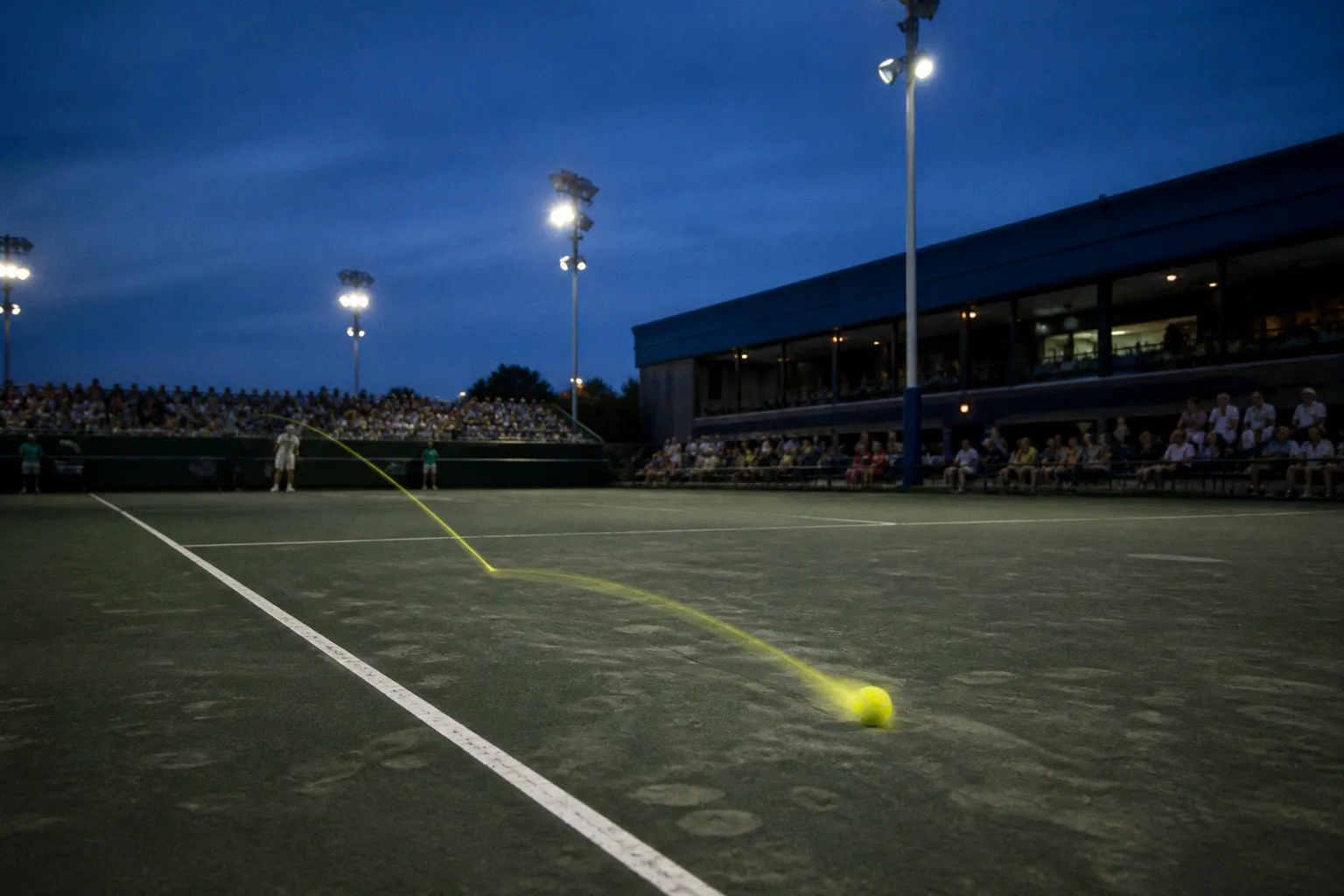
The feet begin drifting backward until the receiver is playing from a different piece of the court.
To the commentary box, this is “buying time”. To the coach leaning over the player box, it is “managing the rhythm”. To the player on the other side of the net, it is a change in the terms of the point: the server has been allowed more space, but the receiver has bought a fraction more time to see, organise and swing.
The 2023 Hawk-Eye ball-tracking analysis that mapped return positions across the professional game did not editorialise. It surfaced two broad clusters, two preferred locations, and a series of triggers that help explain why a player drifts back. The question the data cannot answer on its own — and the one worth asking — is what happens after the return.
When the receiver steps back, who wins the next two shots? How much court has been surrendered? And does the extra reaction time compensate for the recovery problem that arrives immediately afterwards?
The Geometry of Reaction: 11.1 vs 12.5 Meters
The Hawk-Eye analysis parsed thousands of in-play returns and produced a strikingly clean bifurcation. Players do not simply slide backwards in a smooth line as serve speed climbs. They tend to organise themselves around two preferred positions, with the shift between them acting as a tactical decision rather than a continuous retreat.
The first cluster sits at approximately 11.1 metres from the net. On a regulation court measuring 78 feet, or 23.77 metres, from baseline to baseline, that places the returner roughly 0.8 metres inside the baseline. The study labels this the “Short” return position.
The second cluster sits at approximately 12.5 metres from the net, placing the receiver behind the baseline. That is the “Deep” position. The exact distance from the baseline is less important than the distinction itself: one position allows the returner to operate closer to the line and take time away; the other creates a larger visual and temporal buffer against the incoming serve.
The geometry is not philosophical. From the shorter position, the returner has more court in front of them and a simpler path into the next exchange. From the deeper position, the receiver can give the serve more room to enter the hitting window. That extra room may help with a high-speed first serve, a body serve, or a ball that would otherwise jam the swing. But the same retreat lengthens the route back into an attacking court position.
That is the central exchange. The receiver is not gaining time for free. They are borrowing it from the next phase of the point.
The court itself makes the choice visible. A returner inside the baseline is making a statement about time: I can handle the serve early enough to pressure the server. A returner behind the baseline is making a different statement: I would rather see the ball clearly and construct the return than gamble on taking it from a position where the serve may outrun the swing.
Neither statement is automatically correct. The right position depends on the serve, the returner's swing, the bounce, the surface and the quality of the first ball that follows.
The retreat is not psychological collapse. It is pattern recognition running below conscious awareness.
This is why the phrase “standing far behind the baseline tennis return” can be misleading when it is used as a verdict. Depth is not one thing. A player can be deep because the serve demands it, because the player wants a fuller swing, or because the returner has no workable answer from closer in. Those are different tactical realities, even if they look identical from the stands.
Statistical Triggers for Deep Positioning
The trigger map is the most useful part of the data because it kills the lazier explanations. Players do not necessarily step back because they have lost nerve. They step back because the serve has been classified, in the brief interval between the toss and contact, as one that makes the closer position less attractive.
The analysis associated deeper positioning with several features of the serve:
| Trigger | Reported association | Tactical translation |
|---|---|---|
| Higher serve speed | d > 1.02 | Faster serves are strongly associated with the deeper return position |
| First serves rather than second serves | V > 0.43 | The deeper position is much more characteristic of first-serve returns |
| T serves rather than wide serves | V > 0.30 | Centrally directed serves are more likely to trigger the retreat |
These are statistical associations, not mechanical laws. A fast first serve does not force every receiver to move back, and a wide serve does not guarantee that the returner can hold position. The numbers describe tendencies across the tracked sample. They do not eliminate the individual player standing at the other end of the court.
Still, the pattern is coherent. A fast, central first serve gives the receiver less time and less room to swing. The body becomes a target, the contact point becomes less comfortable, and the margin for a compact block narrows. Moving back can create a better view of the ball and allow the receiver to complete a larger movement through contact.
A wide serve presents a different problem. It may pull the returner off the court, but it does not always demand the same retreat. The player may be able to move laterally, use the angle of the serve, or take the ball at a more manageable height. A second-serve kicker to the backhand may also invite a different response: step in and attack, hold position, or retreat only enough to create space for a high contact point.
The useful distinction is not first serve versus second serve in isolation. It is serve type versus returner's preferred solution.
A player with a compact blocking action may take a heavy first serve from close to the baseline and accept a shorter backswing. Another player may need more distance to bring a full forehand into the ball. One returner sees a central serve as an invitation to attack the server's body position; another sees it as a jammed contact waiting to happen.
That is why the deep return baseline distance tennis data matters, but only up to a point. It identifies the conditions under which players tend to change position. It does not prescribe a universal return stance. Positioning statistics are a map of behaviour, not a substitute for the player's technical answer.
The second serve is not simply the opposite
The analysis indicates that second serves almost never trigger the same retreat as first serves. That makes tactical sense. The second serve usually gives the receiver a different combination of speed, height and time. The returner can often stay closer to the baseline, move forward, or at least refuse to surrender as much court before contact.
But “almost never” should not be turned into “never”. A heavy second-serve kick to the backhand, especially on a high-bouncing surface, may still push a receiver away from the line. A player protecting a vulnerable shoulder or managing a difficult return day may also choose more room. The point is that the deeper position is primarily a response to the quality and type of the serve, not a ritual attached to the scoreboard or the point label.
A second serve may be slower and still be difficult. It may arrive high, into the body, or with enough spin to make an aggressive contact point awkward. The receiver's position has to answer that ball, not the category printed beside it.
The Recovery Tax: Why Depth Demands Explosive Footwork
This is where the romantic view of “buying time” meets arithmetic, and becomes less romantic.
A returner standing deep does not simply receive a deeper return position. They also create a longer route back towards the baseline and the centre of the court after contact. The exact recovery distance varies with the player's position, the direction of the return, the quality of the serve and the location the player intends to reach for the next ball. There is no single round-trip figure that applies to every deep return.
That qualification matters. A receiver who retreats behind the baseline but drives the return hard and recovers only to a position a little behind the line is solving a different problem from a receiver who returns defensively and must sprint forward before the server's next shot. The cost is not a fixed measurement. It is a moving tactical bill.
The first line on that bill is the Return +1 — the shot that follows the return. If the receiver cannot recover into a useful court position before the server's third shot arrives, the return, however solid, becomes defensive by default. The server, who has often been holding the baseline through the exchange, now owns the geometry of the court.
This is the contradiction built into deep positioning. The receiver may make the first contact more comfortable while making the next contact more difficult. A deeper stance can turn a rushed block into a proper swing, but the resulting shot may begin from farther behind the baseline and leave the player with more ground to reclaim. If the return lands short, the server may have an uncomplicated first forehand. If the return lands deep and heavy, the receiver may have bought enough time to make the retreat worthwhile.
The returner's court position is therefore only half the calculation. The other half is the quality of the ball produced from it.
The second cost is cumulative. Deep positioning is not a single decision. It is a recurring transaction. Every big first serve, every central serve, and every return game in which the server can repeatedly attack the same contact zone may ask the receiver to accelerate, stop and recover again. Over a long match, those movements matter. But the burden is not identical on every point, and it cannot be reduced to one neat distance.
A player who is naturally explosive may treat that recovery as part of the return pattern. A player with a shorter swing or less confidence in open-court movement may prefer to hold position and accept the risk of a late contact. Surface changes the equation too. On clay, the receiver may have more time to slide or organise the next movement, but the higher bounce can also make the ball more difficult to control from deep. On a faster hard court, the return may stay lower and the next shot may arrive sooner.
The run-off behind the baseline is not the same thing as tactical freedom. It gives the receiver space to stand there, but it does not make the recovery free. Every step back is a choice about what kind of movement will be required after contact.
This is the cognitive load that nobody broadcasts. The receiver is not merely returning serve. The receiver is solving, on every point, a near-real-time optimisation problem:
- How much time does this serve take away?
- Is the extra distance likely to produce a cleaner swing?
- Where will the return land if the player swings from there?
- Can the receiver recover to a position from which the server's next shot is playable?
- Is the same depth still sensible if the serve changes direction or speed?
The best returners answer those questions without appearing to answer them. The feet move before the explanation arrives.
Beyond Depth: The Fallacy of Middle-Court Returns
There is an instinct — common to club players and a worrying number of professionals — that runs like this: if I am going to retreat, I should at least hit the ball deep down the middle, deny the server an angle, and reset the rally.
The instinct is understandable. A central return appears to reduce the server's options. It avoids handing over an obvious cross-court angle, and it gives the receiver a little more room for error. But the value of a return is not determined by depth alone, and centrality is not automatically neutral.
A comprehensive ATP match-charting dataset covering more than 600 professional matches and over 61,000 in-play returns surfaces a finding that should complicate anyone who has built a coaching reputation on “deep middle returns”. On second serves specifically, placement away from the middle of the court was often more effective than simply hitting deep through the centre.
That is a narrower claim than saying one particular direction always wins. The evidence does not establish that hitting away from the middle is universally superior to down-the-line returns, nor does it show that every deep central return is a tactical error. It says that moving the ball away from the middle can be more effective than relying on depth through the centre alone.
The distinction is important because the server's response depends on more than where the ball bounces. A central return can leave the server balanced, close to the centre of the court and able to choose a first attacking ball without having to move. A return placed away from the middle may force the server to adjust the feet, strike from a less comfortable position or reveal the next opening.
But direction has its own price. A return hit too close to the sideline can miss by a small margin or give the server a clean angle. A return directed behind the server may be safer than one aimed for a sharp corner. The point is not to replace one slogan with another. It is to stop treating “deep” as a complete tactical description.
Depth is a court coordinate. Direction is a decision.
The deep position is a permission slip, not a strategy. Spend it on the wrong shot and the server may not need to play well to win the point.
This is where the court-positioning return win percentage becomes difficult to interpret. A player who wins more points from one return position may be doing so because that position is used against particular serves, on a particular surface, or by a player with a particular groundstroke. The position itself may not be the cause. It may be part of a larger package: serve recognition, return direction, recovery speed and the ability to survive the server's first attacking ball.
A deep position paired with a heavy return into a vulnerable zone can be aggressive. A deep position paired with a short central block can be passive. The receiver's feet have moved in both cases, but the tactical meaning is completely different.
What the receiver is really buying
Standing back can buy at least three things:
1. More visual time. The receiver has a slightly longer view of the incoming serve and may be able to read its direction more clearly.
2. A fuller swing. The extra space can make it easier to organise the body against pace instead of improvising a short block.
3. A higher tolerance for serve speed. The player may allow the ball to travel before contact rather than trying to intercept it at the baseline.
It can also cost three corresponding things:
1. Court position. The server retains more territory and may begin the next exchange from a dominant location.
2. Recovery time. The receiver has farther to travel before the next shot, although the actual distance depends on the intended recovery position.
3. Pressure on the return direction. A return from deep has to do enough damage to prevent the server from treating the extra court as an invitation.
That is the full bargain. The point is not won when the returner successfully makes contact. It is won or lost across the sequence that contact creates.
The Nadal Model: Transforming Returns into Groundstrokes
The clearest example of deep positioning used as something other than damage control is Rafael Nadal on clay. His return position was far behind the baseline, and it was not simply a concession. It was a conversion: a way to take a serve that might otherwise arrive as a half-blocked push and reroute it through a full, shoulder-driven groundstroke.
The important point is not to assign Nadal a precise number of feet. The research describes the position as far behind the baseline, and that is the useful description. His stance was a tactical system rather than a fixed measuring-tape exercise. He created space for the forehand, accepted that the ball would travel farther before contact, and tried to turn the return into the opening groundstroke of a clay-court exchange.
The trade-off was non-negotiable. Hitting a real groundstroke from deep could buy Nadal pace, topspin and direction. It also required an immediate recovery towards the baseline because the returner's starting position had left more court behind the contact. If the return landed short or failed to disturb the server's balance, the next shot could arrive with the geometry of a one-shot attack.
The model worked because Nadal was not merely standing back. He was doing something with the space. His forehand swing, balance, movement and tolerance for long clay-court exchanges made the position coherent. The depth allowed him to play a shot he trusted. It was not a universal prescription for how to return serve.
That distinction separates a system from an imitation. A club player can copy the visible distance from the baseline without possessing the groundstroke that justified it. The result is often a defensive return followed by a desperate recovery, which keeps the costs and removes the benefit.
Nadal's clay-court model also depended on the surface. The bounce gave his heavy return a different kind of life, and the slower conditions offered more opportunity for the point to develop after the serve. On faster hard courts, the same starting position can expose the receiver to a quicker Return +1 and a lower margin for recovery. The fact that a position is successful for one player on one surface does not turn it into a general law.
The modern heirs are more situational. Players retreat deep now the way good fielders position themselves in baseball — not as a doctrine, but as a calibrated response to a specific pitch. The best version of the tactic is not “always stand back”. It is “recognise when the serve has made standing back the least bad option, then use the extra space to produce a return that changes the point”.
That final clause is the one most often omitted. Space is only valuable if the stroke that follows can exploit it.
The Verdict: A Tool, Not a Doctrine
The data does not deliver the verdict the commentary box wants. There is no clean headline here — “deep positioning works” or “deep positioning is a myth”. What it delivers is something more useful and less satisfying: deep positioning is a tactical response associated with particular serve conditions, and it pays for itself only when the returner can convert the extra time into a useful ball and recover for what comes next.
The pattern-recognition psychology underneath it is real. The retreat is not cowardice; it is a perceptual system solving a real-time problem below conscious strategy. The 11.1-metre cluster is the position of trust. The 12.5-metre cluster is the position of insurance. Players move between them because the serve changes the value of time, space and court position from one point to the next.
The second serve belongs in that same logic. It is not automatically an invitation to retreat, and the data associates deep positioning much more strongly with first serves. But the receiver still has to read height, spin, direction and bounce. A slow serve can be awkward; a heavy second serve can push the player back; a predictable second serve can invite the receiver forward. The label matters less than the ball.
The same is true of the return direction. A deep central return is not always wrong, and a ball hit away from the middle is not guaranteed to win the point. The confirmed lesson is more modest and more valuable: placement away from the middle can outperform depth through the centre, particularly against second serves, because the returner's objective is to disturb the server's next shot rather than merely send the ball a long way.
The next time you see a returner drifting behind the baseline before a big first serve, the cynical reading is that they have decided not to play the point. The data-driven reading is that they have decided to play a different point, with different geometry, at a different cost.
Whether that decision is a net gain depends on two linked questions. Did the extra space produce a better return? And can the receiver recover into a useful position before the server's next shot?
If the answer to both is yes, deep positioning was tactical sense. If the first answer is no, the retreat was only protection. If the first answer is yes but the second is no, the receiver may have solved the serve and still lost the point. That is the cold math of standing back: the return is not an isolated stroke, and distance is not an advantage until the next ball proves it.