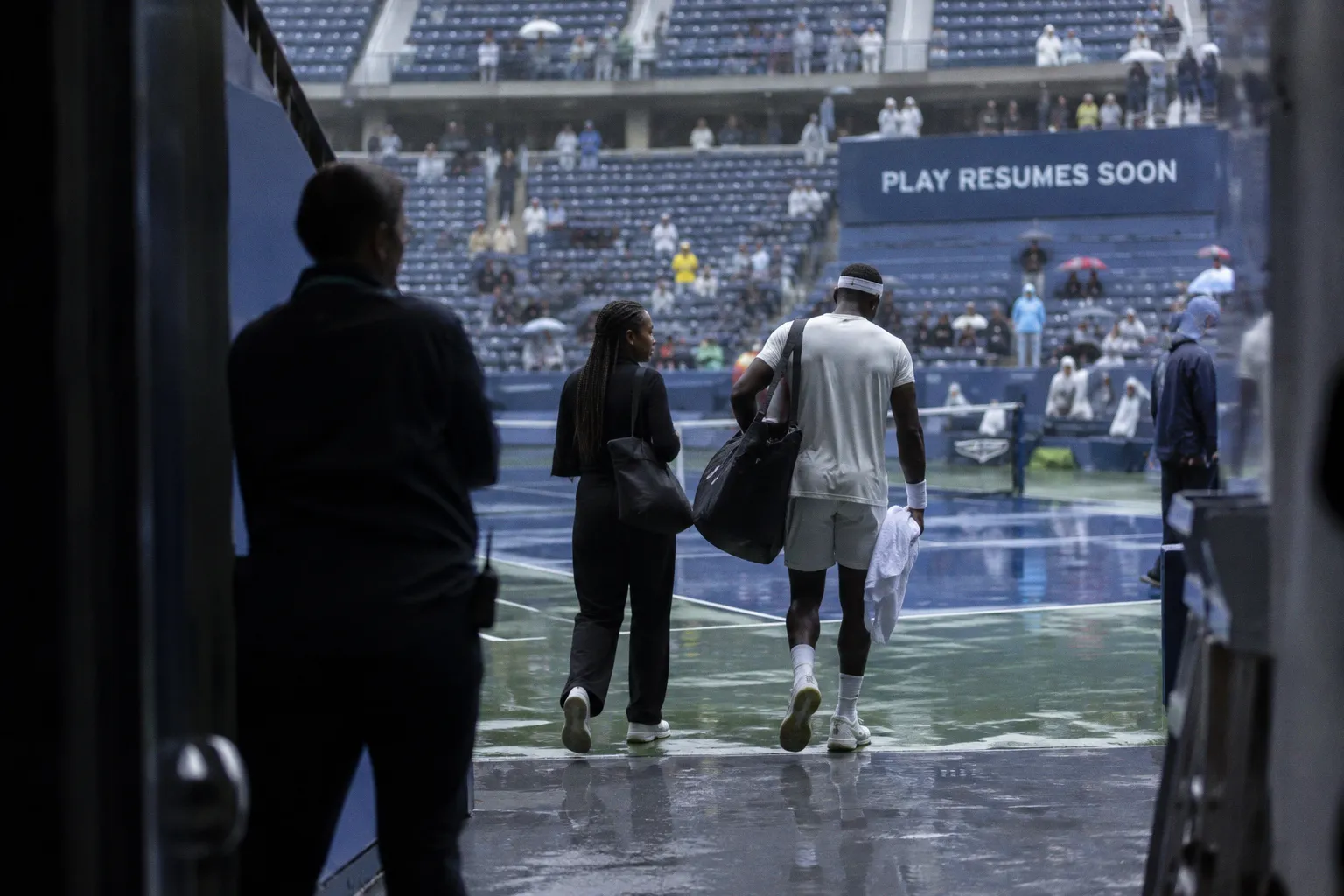
According to The New York Times' U.S. Open briefing, Paula Badosa and Daria Kasatkina walked onto Stadium 17 on Wednesday afternoon and walked off nine minutes and forty-eight seconds later — a surreal, rain-delayed finish to a match that had been suspended at deuce on Badosa's serve more than nine hours earlier. The scoreline read 6-1, 6-4. The mental arithmetic told a far messier story, and it's the kind of tournament theater tennis loves to package as "drama" while the actual texture of those ten minutes is uglier and more interesting than any highlight reel suggests.
Nine hours at deuce
The mechanics deserve a closer look. Badosa had already watched two match points vanish before rain intervened at roughly 10:30 the previous night. She was up 6-1, 5-4, serving at deuce. For nine-plus hours after that, she carried the specific cognitive weight of that moment — not the abstract idea of a tennis match, but the literal grip tension, the visual of Kasatkina's return stance, the scoreboard state — into a hotel room where, by her own admission, she played the match in her head fifty times before falling asleep.
That is not a figure of speech. It is a clinical description of pre-competition anxiety, the kind elite athletes routinely dress up in meditation-and-breathing language for the microphones. Badosa's reported routine — sushi, "sleeping in ten minutes," the "I swear to God" reassurance — reads less like a victory narrative and more like a woman white-knuckling her way through a nine-hour staring contest with her own nervous system. When she told reporters, "I played the match 50 times already, so I felt like I played five set matches," she was being more honest than the sport usually permits.
What Kasatkina offered afterward was the standard-issue athlete bromide: "Honestly, you can't prepare for a situation like that. Nothing can prepare you for this." Fair enough on the surface. But the slightly more cynical read is that the ecosystem rewards that kind of vagueness. Specifics about how the wait actually distorted her timing, her eye, her appetite — the variables that actually determine whether you can serve out a match — never make it past the press moderator.
The context both women would rather you skim past
Badosa's ranking dropped to No. 141 earlier this year. To even be standing on Stadium 17, she had to win nine of ten matches across June and July just to climb back inside the top 100, all while managing a chronic back issue that is now a permanent line in her scouting report. Kasatkina spent the same period dealing with a hip injury and a slide to No. 83. Two players, both rebuilding, both suddenly asked to perform peak concentration across an overnight rain delay.
That context reframes the "mental test" framing nicely. This was not a battle of wills between two fit champions operating at full bandwidth. It was a coin flip between two players whose physical resources were already running on fumes, where the only differentiator was who blinked first in the hotel room at 3 a.m. Badosa's verdict afterward — "We always say that tennis is mental, but this I think was another level of mental" — reads, in that light, less like a flex and more like an admission that the margin was thinner than she'd prefer.
What those sixteen points actually left behind
The closest historical analog, per the same briefing, is last year's Wimbledon restart between Ben Shelton and Rinky Hijikata, which lasted about seventy seconds and produced a winner with zero hesitation. Wednesday's sixteen points were messier: Badosa reportedly swung cleanly to carve out five more match points, then grew visibly tentative with the finish line one away. That is the pattern worth tracking as the tournament deepens. Any player who survives a suspended-at-deuce scenario carries a tell into their next outing — a slight tightening on the first big point, a serve that finds the net on a comfortable lead.
The real lesson from those nine minutes and forty-eight seconds is not that tennis is mental. Everyone in the sport repeats that like a mantra and means nothing by it. The lesson is that the sport's mental demands are unevenly distributed, and the players carrying the heaviest invisible load — the injured, the resliding, the ones clawing back from No. 141 — are the ones most likely to crack the next time the forecast turns.