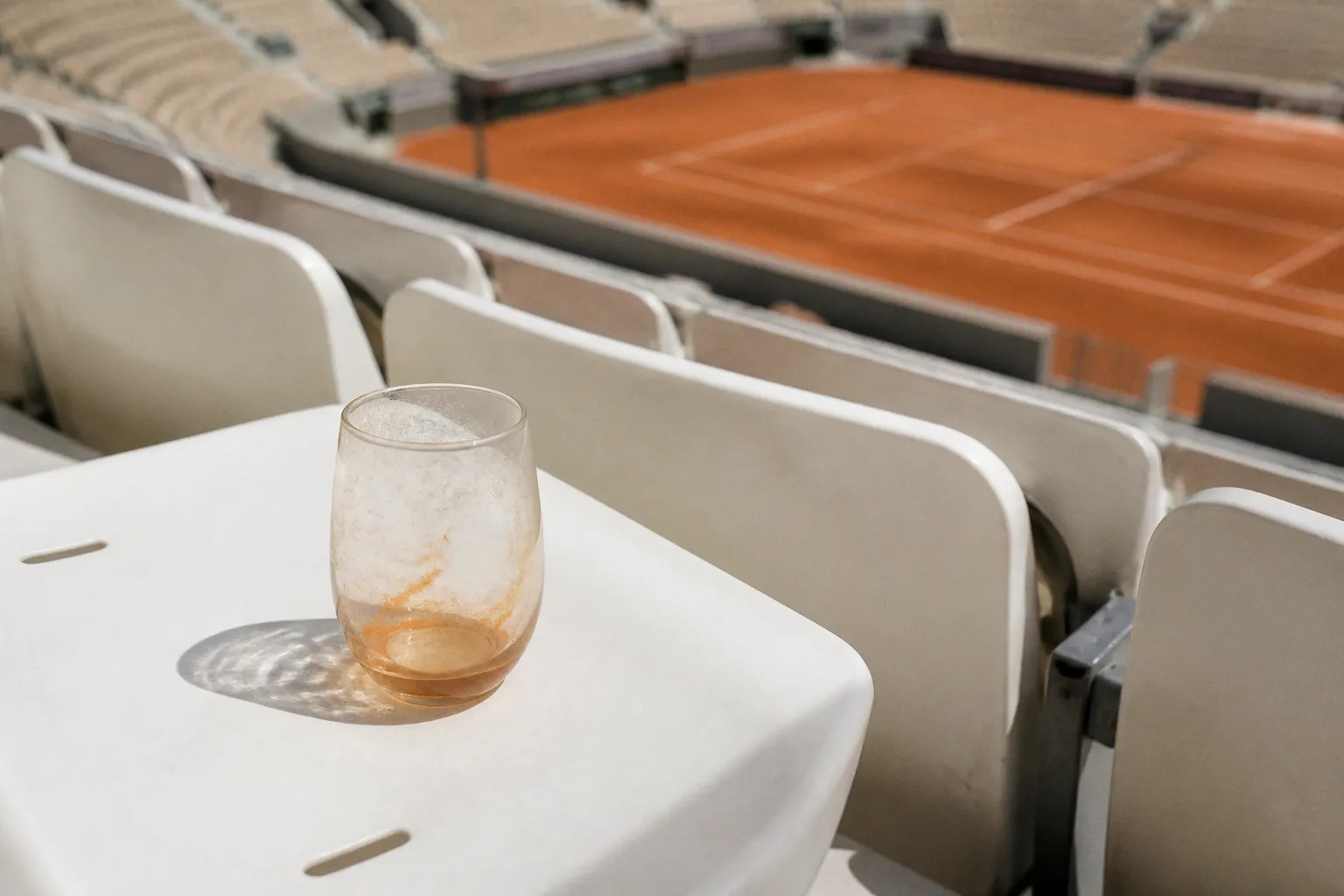
But for the better part of a century, the unwritten deal between Chatrier and its players was straightforward: the spectator paid the entry fee and applauded when the rallies demanded it; the players delivered the theatre. During the tournament’s opening week in late May 2024, that deal visibly frayed — and tournament director Amélie Mauresmo responded in the bluntest language her office permits.
A spectator allegedly spat chewing gum at David Goffin during his match against Giovanni Mpetshi Perricard. Local fans, according to the Belgian, kept up a three-and-a-half-hour soundtrack of insults in his direction. Days earlier, Iga Świątek had stood at the net on Court Philippe-Chatrier and gently, almost wearily, asked her own crowd to stop shouting during points. Something had clearly tipped. On May 30, 2024, Mauresmo announced an immediate ban on alcohol consumption inside the stadium seating areas — a mid-tournament correction that read less like policy and more like a hand finally pressing the panic button.
The response was not a prohibition on drinking across the Roland Garros grounds. It was narrower than that, and therefore more revealing. Alcohol could remain part of the social experience outside the court bowls. Inside them, where a player’s toss, breathing and contact with the ball are exposed to the audience, the tournament was drawing a line.
The question is whether that line repaired the old arrangement between crowd and court, or merely made the problem easier to describe.
The Breaking Point: When Spectator Conduct Overshadowed the Clay
The clay at Roland Garros has always tolerated a particular kind of friction — the squeaking of shoes, the sliding stops, the gallery that grumbles about Hawk-Eye and cheers the underdog with theatrical extravagance. A Chatrier crowd is not meant to be silent in the manner of Wimbledon. It is meant to be involved. The French Open has traditionally sold atmosphere as part of the ticket.
But by the opening week of the 2024 tournament, the friction had become attrition. Players were not losing because of the surface; they were losing because of the airspace above it.
Goffin’s complaints came after a genuinely bruising encounter with Mpetshi Perricard, the kind of match where the bigger server is supposed to dictate and the returner has to grind for any rhythm. To have that grind further complicated by an insult chorus stretching across hours is not a minor nuisance. It is a sustained cognitive load applied to someone already operating at the edge of his physical capacity. The spitting allegation — which organizers were careful not to attribute automatically to intoxication — added a personal dimension. A fan’s saliva does not belong in a player’s peripheral vision at 4–4 in the third, regardless of what the fan has had to drink.
The detail matters because the alcohol ban was never a complete explanation for what happened. A drink may lower the threshold for bad judgment, but it does not create every act of bad judgment. The crowd that shouts during a point is not necessarily drunk. The spectator who insults a player for several hours may be perfectly sober. The person who throws something toward the court may have consumed alcohol, or may simply have decided that the normal rules of public conduct did not apply.
Świątek’s plea, which arrived before the alcohol announcement, carried a different tone entirely. Her appeal was not a complaint; it was, in effect, a public negotiation. She is a multiple Grand Slam champion, a leading figure on clay and one of the players most closely associated with Roland Garros. Even she could not assume the room would give her what she needed to play her tennis. That is a meaningful inversion. Players usually extract silence through performance. Świątek had to ask for it.
The moment a defending champion has to request basic concentration from her own crowd, the tournament has outsourced its discipline to the players themselves.
There is a particular kind of exhaustion that comes from performing under an inattentive room. The body language of a player serving into a crowd that has not gone quiet is unmistakable: the eyes scan the seating bowl before the toss, the legs refuse to commit, the shoulders tighten half a second earlier than they should. Tennis does not often reward public psychology, but the small details are visible to anyone watching closely. The pause before a second serve becomes longer. The player turns away from the baseline. A chair umpire waits for the noise to recede, then waits again because it does not.
The Goffin and Świątek episodes of late May 2024 were, in that sense, not just a series of complaints. They were a visible mechanical breakdown at the level of attention itself. The match had ceased to be a shared performance and had become a negotiation over who controlled the room.
That is the point at which “atmosphere” becomes an inadequate defence. Atmosphere is what makes a tournament feel alive. Intrusion is what makes the players responsible for restoring conditions that the event should already be providing.
The Anatomy of the 2024 Ban: What Changed for Fans at Chatrier
Mauresmo’s announcement was surgically narrow. Alcohol could no longer be consumed in the stands inside the court bowls. It could still be purchased, carried and sipped in the concourses, the walkways and the wide gravel avenues between Chatrier and Lenglen. Anyone familiar with the layout will recognize the gesture for what it was: a delineation of zones.
The officials did not want to prosecute a war on the French Open’s picnic atmosphere. They wanted to reclaim the area where players can hear the ball.
| Element | Before May 30, 2024 | After the ban |
|---|---|---|
| Alcohol in stadium seats | Permitted | Banned inside the seating areas |
| Alcohol in concourses and walkways | Permitted | Still permitted outside the court bowls |
| Crowd noise during points | Controlled through existing officiating practice | Greater emphasis on intervention when conduct crossed the line |
| Spectator removal | Available under ordinary security procedures | More visible expectation that disruptive fans could be ejected |
This distinction is central to understanding the Roland Garros alcohol ban impact. It was not an attempt to turn the French Open into a dry campus, nor a declaration that a glass of wine and a tennis crowd were incompatible. It was a decision about proximity. The farther the spectator is from the court, the less directly a raised voice, a misplaced reaction or a careless gesture interferes with the rally. Inside the bowl, the margin is much smaller.
The restriction renewed itself for subsequent editions, which is the part that matters. A one-week rule is a triage measure. A rule that survives into the following May has become culture — or at least a permanent feature of the tournament’s regulatory architecture. The decision also did something subtler than the headlines suggested. By reframing the problem as alcohol — a tangible, binary, easily policed variable — Mauresmo’s office converted a behavioral story into a logistical one.
The public-relations calculation is obvious. Misbehaving fans become a difficult question about responsibility, crowd culture and the limits of entertainment. Alcohol zones become an operational question. A steward can point to a boundary. A spectator can be told to finish a drink outside the seating area. The tournament can demonstrate that it has acted without having to claim that every loud or hostile fan was intoxicated.
Whether the underlying behavior has actually changed is a different question, and one that requires a longer observation window than the tournament’s most visible incidents provide. The ban may reduce the intensity of some disruptions while doing very little to address others. It can make an ejection easier to justify, but it cannot by itself teach a crowd when participation becomes interference.
There is also the question of symbolism. Roland Garros is, by reputation, one of the more openly consumed of the Grand Slams in terms of on-site leisure. Court-side champagne, late-afternoon rosé on the terraces and the long movement between matches are part of the social lore. Any policy that touches the way the tournament is consumed touches its identity.
By choosing to restrict alcohol in the stands rather than ban it from the grounds, Mauresmo preserved the social surface while redrawing the line where it mattered most — at the precise moment a player serves for a set. The tournament was saying that the drink was not the issue everywhere. It was the issue when the spectator’s leisure began to occupy the player’s concentration.
That is a defensible distinction. It is also a fragile one, because a boundary only works if the event is prepared to defend it when the crowd objects.
Beyond the Glass: The Delicate Balance of Tournament Atmosphere
Every Grand Slam cultivates its own version of decorum, and Roland Garros has historically occupied the more permissive end of the spectrum. Wimbledon practically forbids spontaneous noise on its most important courts and polices Centre Court with the gravity of a chapel. The US Open’s Arthur Ashe Stadium has trained its audience to treat night sessions like Broadway: loud, late, occasionally graceless but mostly self-policing. The Australian Open tolerates a rowdy first-week energy that Melbourne Park has come to trade on.
Roland Garros, traditionally, is the tournament where the crowd thinks out loud.
That tendency is not inherently corrosive. A grumbling Chatrier can be atmospheric in exactly the way a long afternoon on clay demands atmosphere. French tennis audiences have never been passive wallpaper. They react to momentum, question line calls, adopt players and turn a match into a local argument. A court without that emotional weather would be cleaner, perhaps, but also less distinctive.
The problem is not noise in the abstract. It is timing, direction and persistence.
A cheer after a point belongs to the match. A shout during the service motion belongs to the spectator. An ironic reaction to a double fault may be part of the crowd’s rough theatre; repeated abuse aimed at one player is something else. The distinction is easy to describe and harder to enforce because the line moves with the situation. A stadium can be raucous between points and still offer a player the concentration required for the next one. Conversely, a crowd can remain at a steady low roar that never looks dramatic on television but makes every point feel slightly contaminated.
Television has complicated the arrangement. Broadcasts have made casual fans fluent in the rhythms of late-round tennis, while also giving them the reflexive instinct to perform for the camera. The line between participation and intrusion has blurred. What used to be muttered commentary from the back rows is now an unbroken murmur across the whole bowl, with the occasional shout punctuating points at the worst possible time.
Phones add another layer. A spectator who is filming a reaction, checking a message or trying to capture an atmosphere clip is not necessarily behaving badly. But the more live tennis becomes a content backdrop, the easier it is to forget that the court is not a stage waiting for the audience’s performance. Players are not simply supplying a soundtrack for the crowd’s afternoon. They are making decisions under pressure that depend on a very narrow sensory window.
The alcohol ban addresses only one input to that system. It does not touch smartphone etiquette, between-points commentary, the cultural drift toward treating live tennis as a content backdrop, or the simple fact that larger crowds bring greater variance in behavior. What it does do is remove one accelerant from the mixture.
That may be enough to improve the atmosphere without transforming it. A tournament does not need to choose between silence and disorder. It needs to make the distinction between emotional noise and hostile noise legible to the people in the seats.
The French Open fan etiquette that emerges from this will not be a list of prohibitions alone. It will be a shared understanding that the crowd can be expressive without becoming the principal event. The alcohol restriction is useful only if it supports that understanding rather than standing in for it.
Empowering the Umpire: New Protocols for Crowd Control
The other half of Mauresmo’s announcement, less remarked upon but arguably more consequential, was the instruction to chair umpires. Officials were told to be stricter, with explicit guidance to act when spectators crossed decorum lines. Security personnel were similarly empowered to eject.
This is the mechanism that will determine whether the policy survives contact with reality. A rule without enforcement is a press release.
The umpire’s chair has historically been a place of caution on crowd issues. The umpire does not want to halt a match, does not want to become the face of a fan ejection in the middle of a service game and does not want to be accused of overreach in front of a partisan Parisian gallery. A chair umpire is already balancing player complaints, time violations, coaching questions, medical interruptions and the basic need to keep the match moving. Crowd control can look like an avoidable escalation.
But when officials hesitate, the burden moves elsewhere. The player has to wait. The player has to complain. The player has to appeal to thousands of strangers for the conditions that should have been protected by the event. Mauresmo’s instruction shifted the burden of restraint away from the umpire and onto the spectators, which is precisely where it should have sat.
The risk is consistency. A warning at 2–1 in the first set is a courtesy. A warning at 5–5 in the third is a disruption. Where umpires draw that line, and how visibly they do it, will define whether the public reads the new regime as sincere or as window dressing.
There is also a quieter variable: language. Chatrier accommodates a multilingual audience, and officials accustomed to filtering out low-level French chatter may now have to distinguish more carefully between ordinary reaction and targeted abuse. A phrase that sounds like general enthusiasm from one section may be heard by a player as a direct provocation. A chair umpire cannot police every syllable, but can establish a pattern: stop the noise before it reaches the point, address repeated offenders, and make it clear that the seating bowl is not outside the match.
Effective enforcement would probably rely on several small interventions rather than one dramatic removal:
1. Stop the most disruptive noise at the correct moment. A shout during a point, a service motion or a player’s preparation should be treated differently from applause after the rally. Timing is the substance of the rule.
2. Make warnings visible enough to create a social signal. The crowd needs to understand that an official intervention is not a personal quarrel between the umpire and one spectator. It is the tournament stating what the court requires.
3. Use security before disorder becomes a spectacle. Once an offender has turned an ejection into entertainment for the surrounding seats, removal becomes harder and more theatrical. Quiet, early intervention protects everyone.
4. Avoid confusing intensity with misconduct. A French Open crowd should still be allowed to sound like a French Open crowd. If every loud reaction is treated as a violation, spectators will stop trusting the policy and players will lose the atmosphere that makes the event distinctive.
The final point is essential. “Decorum” cannot mean that every court is expected to resemble an examination room. Tennis has always depended on a controlled tension between silence and eruption. The task is not to flatten that tension, but to stop the eruption from arriving during the player’s action or turning personally abusive.
A rule that lives or dies by the umpire’s willingness to invoke it is, in practice, a referendum on the tournament’s nerve.
The same applies to security. Empowerment is not the same as deployment. A policy can give stewards authority while leaving them uncertain about when the authority should be used. If one court permits repeated abuse while another removes a spectator for a single untimely shout, the public will not experience a coherent grand slam spectator policy. It will experience a collection of local customs.
The tournament’s credibility will therefore be measured less by the existence of the ban than by the predictability of its application. Players do not need every match to be quiet. They need to know that someone else is responsible for protecting the moments that must be quiet.
The Future of Fan Etiquette at the French Open
The honest answer to whether the alcohol ban “saved” court decorum is that it is too early to call. Long-term, multi-year empirical data on whether the policy reduced ejections or shifted the noise floor of Chatrier does not yet exist in any clean form. What exists is anecdotal, situational and — like most fan-behavior reporting — shaped by the matches that get televised.
The Goffin and Świątek episodes were visible because they happened in marquee moments. Most disruption at a slam happens elsewhere: in qualifying, on half-full outer courts, during matches in front of small crowds where the camera never lingers. A tournament can appear calm on its signature court while a different version of its spectator policy is being experienced beyond the broadcast frame.
That makes the search for a single verdict misleading. The relevant question is not whether one ban eliminated rowdiness. It is whether the tournament improved the conditions under which rowdiness can be managed.
What can be said is that Roland Garros drew a line it had previously refused to draw. That line matters less for the alcohol itself than for what it signals: a willingness to interrupt the spectator experience in the name of the player’s experience. The tournament accepted that the audience’s convenience was not the only value at stake.
The policy also clarifies the hierarchy of the venue. The concourse is a social space. The court bowl is a performance space. Those spaces can overlap, but they are not identical. A drink that is harmless on a walkway becomes part of a wider behavioral question once the spectator is seated close enough to affect a player’s preparation. The ban makes that distinction physical.
Still, Roland Garros will need more than a boundary around alcohol. It will need a consistent language of intervention, from the biggest court to the smallest one. It will need ushers who understand that fan etiquette is not merely about preventing fights. It includes the less spectacular forms of interference: the shouted instruction, the deliberate delay, the mocking response that continues after a warning, the assumption that a ticket grants permission to test the player’s concentration.
The open question is whether the tournament can enforce that line through the opening week in late May, through qualifying and throughout the quieter sessions when standards are less visible and scrutiny is thinner. It is easy to protect decorum when the world is watching a famous player. It is harder when the court is half-full, the match is not being broadcast and the disruption appears too small to justify a pause.
That is where the real French Open crowd behavior will be decided. Not in the press conference after an extraordinary incident, but in the ordinary accumulation of small decisions: whether a steward intervenes, whether an umpire waits for silence, whether a player is forced to ask twice, whether nearby spectators understand that the person shouting is not expressing passion but taking control of the room.
The other Grand Slams will be watching — not necessarily to copy the policy, but to learn whether a tournament can police the line between atmosphere and intrusion without losing the atmosphere altogether. The tennis calendar has no shortage of different crowd cultures. What works at Wimbledon may suffocate Roland Garros. What feels normal at the US Open may be intolerable on clay. A serious approach to tennis crowd rowdiness rules has to account for those differences while holding on to one common principle: the player’s action comes first.
The clay does not care about any of this. It waits, red and patient, for someone to play on it. The people who play on it have, for the moment, been given one fewer reason to ask the room to be quiet.
Whether that counts as saving court decorum depends on what one thinks decorum is. If it means turning Chatrier into a silent chamber, then no — and it should not. If it means restoring the old bargain, in which the crowd brings emotion but does not demand that the players compete against the crowd itself, then the alcohol ban was a meaningful beginning.
Not a cure. A boundary. And, at Roland Garros, boundaries are often what keep the line from being crossed.