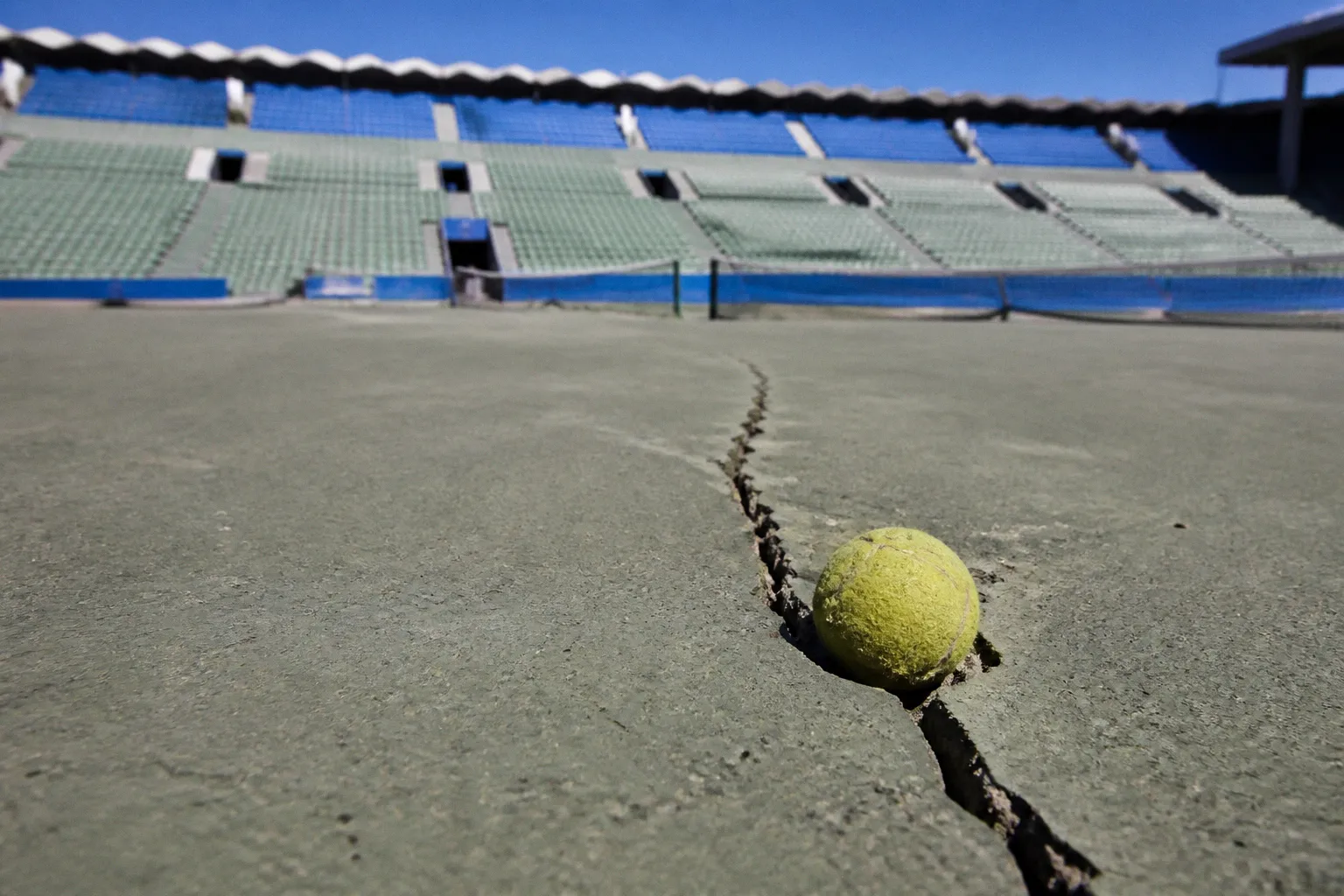
Rebound Ace: how Melbourne's melting courts changed tennis
The shoe plants, the pivot begins, and the court answers like wet tarmac. By the third set, the legs go quiet. The shoulders tighten. The mind follows. This was Rebound Ace in its late-evening light — a surface that promised tennis something new, then betrayed it in the heat.
The court was not literally melting beneath the players. That shorthand is too neat, and technically wrong. The problem was subtler: under extreme heat, the interaction between the cushioned layers, the acrylic finish, the shoe sole, and the player's movement could change in ways that made the surface feel tacky and unpredictable. The scoreboard did not record the moment a player decided, mid-rally, not to slide. It recorded the unforced error that followed.
For two decades, the courts at what is now Melbourne Park were the most distinctive visual signature in the sport. Rebound Ace — a cushioned hard-court system built from polyurethane rubber, fiberglass, and acrylic layers over an asphalt or reinforced-concrete base — became the Australian Open's defining stage from 1988 through 2007. In that time, the surface produced champions, controversies, and one of the most persistent court-surface disputes professional tennis has seen.
Its story is not simply one of technological progress. Rebound Ace was not replaced because tennis suddenly discovered that soft courts were bad and blue courts were good. It was replaced because a surface designed to make hard-court tennis more forgiving became difficult to defend when the Melbourne summer exposed its limits. The history of Rebound Ace is therefore also a history of the professional game learning that a court is never just a court. It is a piece of engineering, a television image, a commercial asset, and — eventually — part of the injury conversation.
The Rise of the Rubberized Court: 1988 at Flinders Park
The Australian Open did not become a January fixture by accident. For years, the tournament had drifted through the calendar — December, January, sometimes uncomfortably close to Christmas — before the decision to establish a mid-January window gave the event a clearer place in the Grand Slam season. It also brought an obvious environmental problem into focus: Melbourne in summer is not a forgiving laboratory for outdoor sport.
The tournament's move to the new Flinders Park complex created an opportunity to rethink the playing surface as well as the venue itself. Rebound Ace was the choice. When the complex was renamed Melbourne Park in 1996, the surface had already become inseparable from the event's identity.
It was not a modest technical adjustment. Rebound Ace was a layered system: polyurethane rubber and fiberglass over an asphalt or reinforced-concrete base, finished with an acrylic topcoat. Compared with the bare-acrylic hard courts that had dominated the previous era, it offered a degree of cushioning intended to reduce the harshness of hard-court play. The promise was easy to understand. Tennis could remain fast, durable, and commercially practical without requiring every movement to be absorbed by a rigid slab.
The on-court product gave that promise a convincing shape. Rebound Ace produced a high bounce and a medium-paced game. It rewarded aggressive baseliners, but it did not punish defenders quite as severely as a faster, harder court might. The ball sat up. Players had time to organize their next shot. Long rallies were possible without making the court feel slow in the manner of clay.
That balance mattered because the Australian Open was still establishing its modern personality. Wimbledon had grass. Roland-Garros had clay. The US Open had its own hard-court character. Melbourne needed a surface that was not merely serviceable but recognizable. Rebound Ace supplied one.
The color helped. The courts were a vivid, almost synthetic green — closer to lawn than to the muted tones associated with many hard courts — and they read beautifully on television. A generation of Australian summer tennis was framed by that green. The opening fortnight of the season looked unlike any other event on the calendar, and the surface was the reason.
Rebound Ace was not just a playing surface. It was the visual shorthand for January tennis.
A court with its own accent
Surface debates often become too technical too quickly. Pace ratings, force absorption, resin chemistry, and base construction matter, but players experience those things through timing and movement. Rebound Ace had an accent. The ball came up with conviction. The court allowed a player to build a point rather than merely survive the first exchange. A deep return did not end the conversation; it opened it.
That was especially significant during a period when the professional game was becoming increasingly physical. The baseline was expanding as a tactical territory. Players were expected to defend wide, recover quickly, and repeat explosive movements for hours. A cushioned hard court looked like a way to make that future less punishing.
The tension was already present, though. Cushioning does not automatically mean comfort. A softer construction can reduce some impact while still producing a complicated relationship between traction and release. The foot needs to grip long enough to support a change of direction, but not so long that the shoe remains trapped when the body has already begun to rotate. Rebound Ace was celebrated when that relationship felt stable. It became controversial when the balance shifted.
The Physics of the Bounce: Why Players Trusted the Cushion
Strip away the politics and the marketing, and Rebound Ace was, by design, a softer surface. Force-absorption figures associated with top-tier Rebound Ace HSA 5 systems sat in the 12–14% range, meaningfully higher than the bare-acrylic courts that represented the late-1980s industry standard. That additional absorption meant less shock traveling through the leg on hard landings — at least in principle — and helped explain why the system appealed to players and tournament organizers.
The benefit was not only medical or mechanical. It changed the rhythm of a point.
The higher bounce gave baseliners more time to set up. A player could defend deep and still get the ball back above the net with enough height to reset the exchange. The surface offered a margin that rewarded patience, weight of shot, and the ability to redirect pace. It was not a court for one-dimensional tennis. A big serve mattered, but the serve did not settle every argument.
Serve-and-volleyers complained, as serve-and-volleyers always do when tournaments drift toward medium pace. Big servers groused. But the bulk of the tour — grinders, counterpunchers, and players who built their games around depth and repetition — found a surface that suited them.
The cushion also altered how players moved. On a hard court, the body is always negotiating impact: the landing after a serve, the braking step at the end of a sprint, the recovery toward the center of the court. Rebound Ace softened those contacts enough to feel different from traditional acrylic. The surface did not turn a hard court into clay, but it gave the player a little more room between the explosive movement and the punishment that followed.
That room was part of the court's appeal. A player could slide into a defensive position, recover, and remain in the point. A player with a heavy, repetitive game could ask the legs to perform the same task again and again. When the footing was consistent, the system felt forgiving without becoming passive.
Trust is a performance variable
Then there was the psychological component, and this is where Rebound Ace became more than a material.
A predictable bounce is a confidence surface. A player who trusts the footing plays loose, plays forward, and takes risk. A player who does not trust the footing plays tight, plays conservatively, and retreats into the safe patterns that win ugly but win rarely. The difference may be only a fraction of a second, but professional tennis is built from fractions of a second.
Footwork is not background activity. It is the hidden structure of every shot. The player does not simply decide to hit a forehand; the player decides where to place the feet, how hard to push off, whether to open the hips, and how aggressively to recover for the next ball. If the surface makes any of those decisions uncertain, the uncertainty spreads through the stroke.
A high bounce you can read is a confidence surface. A bounce you cannot read is a slow-motion panic attack played out across five sets.
For most of Rebound Ace's reign, the surface belonged comfortably in the first category. That is what made the later complaints so damaging. They were not complaints about an unfamiliar court. They came from players who knew exactly how the court was supposed to feel and noticed when it stopped feeling that way.
When the Surface Turned: Heat, Friction, and the Sticky Court Controversy
Melbourne in late January is not a polite environment for an outdoor polyurethane surface. Air temperatures can move into the high thirties Celsius, and exposed court surfaces can become substantially hotter than the surrounding air under direct sun. The surface system itself was not simply liquefying. The more accurate description is that heat changed the behavior of the court's materials and the frictional relationship between the finish and the shoe.
That distinction matters. “Melting” became the memorable word because it captured the sensation players were describing, not because the court was literally turning into liquid. A surface can become problematic long before it reaches a dramatic failure point. Small changes in tackiness, release, and energy return are enough to alter a professional player's movement.
The complaints began as whispers and grew into a chorus. Players reported that the surface became sticky in the heat. The shoe would plant cleanly but not release cleanly. Pivots and slides — the small, often unconscious movements between shots — became treacherous. Some described a tacky sensation underfoot. Others believed the interaction between the shoe rubber and the acrylic topcoat could pull up small flecks from the finish.
The issue was not that every court behaved identically or that every player experienced the same problem. Court preparation, shade, time of day, humidity, shoe construction, and individual movement patterns could all affect the sensation. That variability was part of the controversy. A surface that felt perfectly manageable in one session could become an entirely different opponent in afternoon heat.
By the mid-2000s, the debate had hardened around a more serious question: whether Rebound Ace was associated with a higher rate of knee and ankle injuries than other hard courts.
The official responses were cautious. Investigations by the ATP and WTA tours examined injury patterns and did not assign direct blame to Rebound Ace. Tournament officials maintained that there was no conclusive evidence proving the surface was more dangerous than competing hard courts. That finding did not settle the argument, because the players' complaint was not limited to a simple question of whether the court caused a particular injury.
The more immediate question was whether the court changed movement in a way that made injury more likely, or at least made players feel exposed. A laboratory result could tell organizers about force absorption. It could not fully capture the hesitation before a pivot, the shortened recovery step, or the decision not to push off at full speed.
What happened on the court was visible to anyone watching closely enough. Players who had trusted the surface for years began adjusting: shorter swings, more conservative footwork, and a creeping reluctance to push off fully on one side. Some of those adaptations may have been rational responses to conditions; others may have been the natural caution that develops once a surface acquires a reputation. Either way, the reputation became part of the playing environment.
The mental cost is the part the scoreboard does not show. When footing is unreliable, every shot becomes a decision tree. Every pivot becomes a gamble. The cognitive load rises, the shoulders tighten, and the game that lived in the legs starts living in the head. By the third set of a five-set match in intense afternoon heat, the surface was no longer a stage. It was an opponent.
The scoreboard does not record the moment a player decides, mid-rally, not to slide. It records only the unforced error that follows.
Why the controversy refused to disappear
The Rebound Ace dispute survived because neither side could reduce it to a clean verdict.
The organizers could point to a cushioned system designed to reduce impact. Players could point to what happened when they tried to change direction on a hot court. Engineers could discuss test conditions. Competitors could describe a foot that failed to release at the precise moment the body committed to the turn. Both accounts could be true.
There was also a communications problem. The Australian Open was building itself into a global event, and the green court was part of the product. Admitting that the most recognizable element of the tournament had a behavior problem would have meant admitting that the event's visual signature came with a material qualification. The language therefore moved toward consistency of bounce and pace — safer, more measurable terms than stickiness or injury risk.
That did not make the technical concerns irrelevant. It made them easier to manage publicly. A court can be replaced because it is inconsistent without an organizer formally declaring it unsafe. In professional sport, that distinction is often the difference between a technical upgrade and an institutional confession.
The Transition to True Blue: Why Tennis Australia Abandoned Rebound Ace
The official decision came on May 30, 2007. Tennis Australia announced that Rebound Ace would be replaced for the 2008 tournament by Plexicushion. Tournament director Craig Tiley framed the change around the findings of a year-long study, emphasizing concerns about the consistency of the surface's bounce and pace.
The framing was deliberate. Tennis Australia did not say the court was melting underfoot. It did not say Rebound Ace was injuring players. It presented the switch as a measurement-driven correction to an inconsistent playing environment. That language put distance between the decision and the injury controversy that had been gathering for years.
The technical case for the change was reasonably straightforward. Plexicushion was also a cushioned acrylic system, but it used a different resin and construction profile intended to produce more stable behavior under Melbourne's summer conditions. The composition was different. The color was different. When the 2008 Australian Open began, the courts were no longer green. They were the now-iconic Australian Open True Blue — a deeper, more saturated blue that read instantly on television and gave the tournament a new visual identity.
The change was therefore both technical and theatrical. Tennis Australia could present a surface designed for greater consistency while also presenting a tournament that looked newly modern. The blue courts separated the Australian Open from its green past in a single broadcast frame.
The comparison is worth drawing out clearly:
| Parameter | Rebound Ace | Plexicushion | GreenSet |
|---|---|---|---|
| Australian Open period | 1988–2007 | 2008–2019 | 2020–present |
| Basic court type | Cushioned hard court with polyurethane, fiberglass, and acrylic layers | Cushioned acrylic hard court system | Acrylic hard court system used for the modern Australian Open |
| Court color associated with the era | Green | Australian Open True Blue | Blue playing area with the tournament's current visual treatment |
| Main technical discussion | Cushioning, bounce, traction, and heat-related consistency | More consistent pace and bounce under tournament conditions | Continuation of a controlled, modern hard-court environment |
| Public controversy | Sticky footing and inconsistent behavior in extreme heat | A quieter surface debate, without the same sustained Rebound Ace backlash | Current surface era; too recent to carry the same historical distance |
| Role in tournament history | Defined Melbourne tennis for two decades | Bridged the green Rebound Ace era and the current surface | Australian Open surface since 2020 |
The timeline matters. Plexicushion was not the Australian Open's surface “since 2008” in perpetuity. It was used from 2008 through 2019. GreenSet became the Australian Open surface in 2020 and remains the correct reference point for the current era.
That correction is more than a footnote. Surface history is often flattened into a simple before-and-after story: green Rebound Ace, then blue Plexicushion. In reality, Melbourne has had three distinct modern surface eras. Rebound Ace established the tournament's identity, Plexicushion delivered the first major reset, and GreenSet represents the surface now associated with the event's present-day conditions.
Tennis Australia sold the replacement as an upgrade. The reality is more complicated. Rebound Ace had become a liability — not necessarily because it was uniquely bad, but because the conversation around it had become uniquely loud. Every hot January afternoon reopened the argument. Every awkward movement could be interpreted through the surface's reputation. The tour could no longer afford to manage that conversation indefinitely.
The replacement was not an admission of failure. It was the quietest possible exit from a fight the organizers were no longer winning in public.
Rebound Ace versus Plexicushion: what actually changed?
The phrase “Rebound Ace versus Plexicushion” suggests a neat technical duel, but the comparison is more useful when treated as a comparison of eras rather than a contest between two universal substances. Both were cushioned hard-court systems. Neither name, by itself, tells you everything about a particular court's speed, traction, or response. Installation, maintenance, weather, and the underlying base all matter.
What changed in Melbourne was the tournament's priority.
Rebound Ace carried the promise of softness and a distinctive bounce, but its behavior under heat became the defining story. Plexicushion was chosen in part because it offered a more predictable performance profile and because it allowed Tennis Australia to leave the sticky-court controversy behind. The blue color did not solve the physics. It helped mark the beginning of a new contract with the players and the audience: the court would be presented as a controlled, modern surface rather than an unpredictable relic of the previous generation.
That contract was eventually renewed again with GreenSet in 2020. The Australian Open did not return to Rebound Ace, and the tournament's surface history moved forward without pretending that the earlier era had never happened.
A Lasting Footprint: From Melbourne Park to the Sydney Olympics
Rebound Ace did not vanish quietly. Its most visible afterlife came at the 2000 Sydney Olympics, where the tennis venue at Homebush Bay used Rebound Ace in front of a home crowd and a global television audience. The Olympic deployment was a reminder that the surface, at its best, was world-class. It could host high-level tennis, withstand the demands of a major event, and give a tournament a coherent identity.
The Sydney example also complicated the Melbourne narrative. If Rebound Ace was simply defective, its Olympic use would be difficult to explain. But surfaces do not behave in a vacuum. A court's performance depends on climate, installation, maintenance, scheduling, and the particular stresses placed on it. A manageable Olympic fortnight does not disprove a recurring problem at the Australian Open. It demonstrates that the same general system could produce different experiences under different conditions.
That distinction is important when looking back at the Australian Open's court-surface history. Rebound Ace was not a failed experiment from the day it was installed. It was a successful system whose weaknesses became more consequential as the tournament grew, the players became more physically extreme, and the January heat remained immovable.
The court as a piece of tournament identity
What Rebound Ace left behind is harder to quantify. It helped normalize the cushioned hard court as a serious tour-wide option — the idea that professional tennis did not have to be played on something that behaved like bare concrete. It also made surface engineering part of the public conversation.
Before the Melbourne controversy, most viewers experienced a court primarily through its color and pace. After it, the public understood that the layers beneath the paint mattered. Resin, cushioning, friction, bounce, and temperature were no longer obscure maintenance details. They had become part of the drama.
Every modern cushioned hard court lives in the shadow of that trade-off. Cushioning can reduce some impact, but it cannot remove the mechanical demands of stopping, turning, and recovering. A surface can be comfortable under one set of conditions and awkward under another. The relevant question is not whether a court is soft or hard in the abstract. It is whether it remains predictable when the player, the weather, and the match are all asking the most of it.
Plexicushion, used at the Australian Open from 2008 through 2019, represented a quieter chapter in that story. It did not create the same sustained player revolt that Rebound Ace did in its final years at Melbourne Park. GreenSet, adopted for the Australian Open from 2020 onward, marks the current chapter. The change does not erase the controversy. It shows how tournament surfaces evolve: not only through laboratory specifications, but through accumulated trust.
The deeper legacy is psychological. For a generation of players who came of age in the 1990s and 2000s, Rebound Ace was a surface they had to negotiate with — not a neutral stage but an active participant in the match. The best adjusted and never thought about it. Others carried suspicion of the surface into their footwork, shot selection, and decision-making under pressure.
That is the question Rebound Ace ultimately posed to every player who stepped onto it: do you trust the court, or do you fight it?
Tennis Australia stopped asking that question when it changed the surface. The green disappeared, then the first blue era gave way to another. But the lesson remained. In professional tennis, a court does not have to literally melt to change the game. It only has to make a player hesitate.