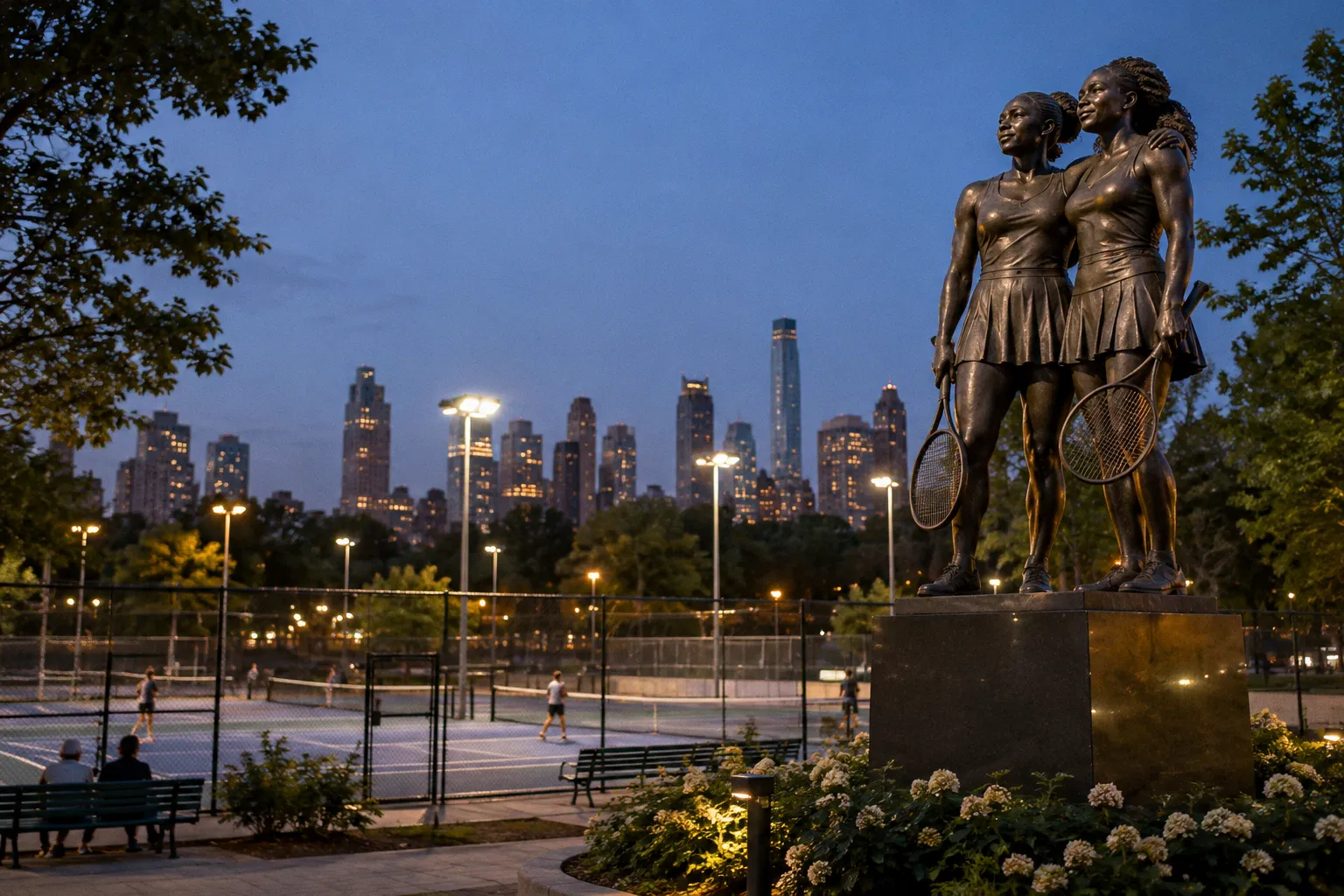
According to a New York Times reconstruction of Black excellence in American tennis, the past 48 hours at Flushing Meadows produced a convergence the sport hasn't manufactured in over half a century — a flag bearer, a Grand Slam finalist, and a doubles champion, all arriving within the same tournament week. It's not a feel-good montage. It's a ledger catching up, and the cognitive load of being a "first" in this sport runs far deeper than any trophy speech can reach.
The Weight of the Name on the Stadium
The last time a Black man played a U.S. Open men's final, Arthur Ashe's name was still fresh on the honors board. On Sunday, Ben Shelton gets his turn against Alexander Zverev — and the psychological freight of that gap should not be flattened into a heartwarming headline. Ashe's last championship-match appearance was 1972. The stadium now carries his name. Fifty-four years of men who could have been and weren't.
Shelton isn't carrying that alone. He's running a relay where the baton has been dropped, deflected, and occasionally snatched away. Consider James Blake, who around 1990 — at twelve, in central Connecticut — entered a regional under-12 tournament lottery, lost, was told by organizers that every also-ran was guaranteed entry to the next event, and then watched the same director refuse to honor the promise. "My mom pitched a fit," Blake would later recall. Blake won the tournament anyway. The director who tried to lock him out didn't hand him the trophy when it was over; someone else did.
That single scene, preserved in the Times' historical reconstruction, is the whole story compressed: the gate, the gatekeeper, the parent as battering ram, and the player who still has to win the thing twice — once against the opponent, once against the room. Blake eventually climbed to No. 4 in the world. He should have been there sooner, and he knows it.
The Williams Unlock
Coco Gauff, sitting in a quiet Paris room before the 2024 Olympics, put her finger on the mechanism without quite meaning to. Chris Eubanks had called to tell her she'd been voted U.S. flag bearer. She thought about what it meant — a Black woman carrying the flag in what she called a "predominantly White sport" — and then did something most champions instinctively resist. She credited the path. "Each one of them would tell you that Serena and Venus has played some part in their story," she said, before naming Ashe and Gibson as the deeper lineage.
Strip the reverence and what she's describing is permission architecture. Before the Williams sisters, the default assumption inside American tennis was that Black excellence was a footnote — Gibson, Ashe, a roll call that stopped being updated. After them, the assumption had to be rewritten. Blake made No. 4. Gauff took a Grand Slam title at nineteen. Shelton reached a major final. None of those trajectories are thinkable in a sport that hadn't been pried open first.
What the federation press releases and the diversity-and-inclusion brochures won't say — what the institutional PR smooths over with practiced warmth — is that the permission was extracted, not granted. The Williams sisters didn't request entry politely. They broke the door, kept winning, and forced every tournament director tempted to run the Connecticut lottery trick on their successors to reckon with the reputational cost. That recalibration is what Shelton walks into on Sunday. It is also what every Black American player in the draw this fortnight is still spending energy maintaining.
What the Next 48 Hours Actually Mean
By Friday, the ledger had already moved. Gauff had played her second U.S. Open semifinal. Taylor Townsend, paired with Kateřina Siniaková, lifted the women's doubles trophy. Robin Montgomery and Ashlyn Krueger were on the other side of the net in that final — meaning both championship partnerships were anchored by Black American players, a structural detail the highlight reels will probably bury.
The men's final is the headline. The doubles result and the semifinal run are the connective tissue — proof that this isn't a single comet but a constellation that the sport's gatekeepers spent fifty years refusing to look up at.
The question isn't whether tennis is changing. Tennis has been changing for three decades, slowly enough that an Ashe-finalist drought could stretch across fifty-four of them. The question is whether the institutions that still organize under-12 lotteries in central Connecticut have caught up. The historical evidence is that they catch up only when someone's mother pitches a fit, when a flag-bearer vote comes back unanimously, or when the trophy gets handed off by someone other than the person who tried to keep you out.
Watch the final. Watch how the cameras frame the handshake. Watch whether the post-match interview asks Shelton about the historical weight, or about his forehand. The latter would be progress. The former would at least be honest.